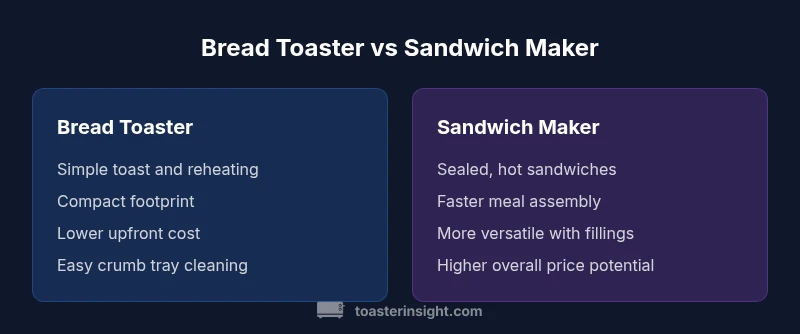
Bread Toaster vs Sandwich Maker: A Comprehensive Comparison
An objective side-by-side comparison of bread toasters and sandwich makers, covering performance, features, price, and best-use scenarios for home kitchens.


Bread toaster vs sandwich maker: For pure toast quality, a bread toaster excels with predictable browning, simple operation, and quick breakfast duty. A sandwich maker, by contrast, provides sealed, hot sandwiches and faster meal assembly. This comparison highlights when each appliance shines and where trade-offs arise for everyday home cooking.
Context and definitions
According to ToasterInsight, the bread toaster and the sandwich maker occupy adjacent corners of the small kitchen toolbox. Both devices are designed to turn bread into warm, edible food, but they approach the task with different assumptions about versatility, user effort, and space. Readers typically ask which device delivers better toast for daily breakfasts and whether the sandwich maker can replace a separate grill or panini press. The reality is that the answer depends on how often you want genuine toast versus sealed sandwiches, how much counter space you can spare, and how much you’re willing to invest upfront. In this guide, we use bread toaster vs sandwich maker to explore performance, ease of use, cleaning, and long term value. You’ll learn which appliance is best for your typical meals and kitchen setup.
How heating works in bread toaster vs sandwich maker
Bread toasters rely on hot coils and a controlled airflow to brown bread evenly. The slices slide into slots, and a lever or electronic control determines browning level. In contrast, a sandwich maker uses two heated plates that come together to grill, seal, and heat fillings from both sides. Some models preheat quickly, while others rely on timers and indicators. The result is a crisp exterior with warm interiors, but texture and moisture behavior differ markedly between the two approaches. Understanding these mechanisms helps set realistic expectations for texture, time, and the type of meals you can confidently prepare.
Browning control and results
Browning controls on a bread toaster are typically dial based or sequence presets that aim for consistent color on plain bread. The results are usually uniform with minimal risk of sogginess, provided you monitor the cycle. A sandwich maker emphasizes searing the exterior while trapping steam inside, which can melt cheese and warm fillings efficiently. The trade off is that the interior moisture level may vary and overfilling can affect sealing. In daily practice, expect crisper toast from a dedicated toaster and more molten centers from a sandwich maker when cheese is involved. Both devices can produce excellent outcome with mindful loading and cycle timing.
Sealing mechanism, fillings, and containment
A core difference lies in sealing and containment. The sandwich maker seals the bread around fillings, creating a single portable pocket. This design is ideal for paninis and grilled cheese but can limit fillings that require loose ingredients. A bread toaster lacks a seal, which makes it perfect for traditional toast, bagels, and simpler reheating tasks where fillings are not involved. If your typical meals feature melted cheese and sealed textures, a sandwich maker offers advantages; if you mostly want light toasting and reheat, a traditional toaster will be more straightforward and less prone to leakage.
Space, design, and durability considerations
In compact kitchens, both devices can fit under cabinets, but their footprints differ. Bread toasters are often narrower and lighter, with crumb trays and slot access that make cleaning easy. Sandwich makers tend to be a bit bulkier due to lid architecture and plate hinges, though many models offer compact, vertical designs for small counters. Durability hinges on build quality and nonstick coating; both devices benefit from regular crumb cleaning and careful handling of hot surfaces. If counter space is at a premium, a compact toaster may edge out a sandwich maker, but if you value integrated sealing and fast meal prep, the sandwich maker could be worth the extra footprint.
Cleaning and maintenance routines
Maintenance for a bread toaster is usually straightforward: empty crumbs from the tray, wipe outside surfaces, and periodically brush slots to prevent residue buildup. A sandwich maker requires more attentive cleaning of the plates to prevent cheese and sauce from sticking. Nonstick coatings simplify removal of sticky fillings, but avoid metal utensils that could scratch coatings. Both devices benefit from drying thoroughly after washing and storing in a dry location. Regular maintenance helps preserve browning performance, reduces odor transfer, and extends overall lifespan.
Price ranges and long term value considerations
Price ranges for bread toasters generally sit at the lower end of the market, giving buyers an affordable entry point for reliable toasting. Sandwich makers often carry a midrange price, reflecting added capabilities such as sealed grilling and even heating across both plates. When evaluating long term value, consider how often you will use sealed sandwiches and whether you’ll benefit from easier cleanup or faster meal assembly. If your meals are mostly toast, a budget toaster typically delivers better per dollar value; for frequent sandwich meals, a sandwich maker provides better versatility and convenience.
Use-case profiles: households, students, families
Student dorm rooms benefit from compact toasters that deliver quick breakfasts with minimal setup. Busy families or professionals may prefer a sandwich maker for fast lunches and dinner shortcuts, especially when time is tight and cheese melting is common. Home cooks who enjoy experimenting with different fillings can appreciate the versatility of a sandwich maker, while purists who savor toast texture and color will favor a traditional bread toaster. Reading user reviews and cooking anecdotes helps align device choice with personal routines and dietary preferences.
Accessories and model variety
Model variety matters when choosing between these devices. Toasters come with varied slot counts, browning presets, and crumb tray designs. Sandwich makers offer plates with nonstick coatings, interchangeable plates, and adjustable temperature or timer options. If you anticipate experimenting with bread types like sourdough or rye, check for even heating and the ability to accommodate thicker slices. Accessories such as extra plates, adjustable lids, or compact vertical designs can influence where a unit fits in your kitchen and how easily you can keep it clean and ready for daily use.
Common myths and misperceptions
One common myth is that a sandwich maker can completely replace a traditional toaster. In reality, toasting bread achieves a different texture and browning profile. Another misconception is that sealed sandwiches always cook faster; timing depends on fillings and plate design. Some buyers assume that more features equate to better performance; however, extra functions can complicate use and maintenance. A focused approach—matching device capabilities to your most common meals—often yields the best long-term satisfaction.
Quick-start buying checklist
Before purchasing, confirm your primary goal, whether it is simply toast or versatile sealed sandwiches. Check for slot configuration, browning controls, and plate coatings. Consider counter space, dishwashability, and how easy it is to clean. Compare price-to-performance ratios and read recent customer reviews to gauge real-world reliability. Finally, verify warranty terms and replacement part availability to protect your investment over time.
Authoritative sources and further reading
For general safety and appliance care, consult authoritative sources such as the Consumer Product Safety Commission and major public health and safety organizations. These references provide guidelines for safe operation of small kitchen appliances and maintenance practices that help prevent accidents and extend appliance life.
Comparison
| Feature | Bread Toaster | Sandwich Maker |
|---|---|---|
| Best use-case | Simple toast and reheating | Sealed sandwiches with built-in grilling |
| Browning control | Dial presets and timed cycles | Temperature presets with pressurized plates |
| Cooking method | Open slots with direct heating | Closed cavity grilling with dual plates |
| Size and footprint | Typically compact; fits narrow counters | Slightly larger due to lid and hinge mechanism |
| Ease of cleaning | Crumb tray; easy slot cleaning | Nonstick plates; may require more careful cleaning |
| Energy use | Usually lower power for toast | Higher power when heating fillings |
| Price range | $15-$60 | $25-$90 |
| Best for | Everyday toast routines | Versatile sandwich cooking |
Positives
- Simple, reliable operation for everyday toast
- Compact footprint fits small kitchens
- Typically lower upfront cost than multifunction appliances
- Easier cleaning for crumb trays and slots
Drawbacks
- Limited versatility compared to sandwich makers
- Potential for over-toasting if not monitored
- Sealed grilling capabilities are not present in a traditional toaster
Bread toaster wins for pure toasting performance and simplicity; sandwich maker wins for versatility and sealed sandwich cooking
Choose a bread toaster if your main goal is consistent, quick toast with minimal cleanup. Opt for a sandwich maker if you regularly prepare sealed, hot sandwiches and want faster meal assembly; balance with counter space and desired maintenance.
Your Questions Answered
What is the main difference between a bread toaster and a sandwich maker?
The main difference lies in function. A bread toaster excels at even browning of bread for traditional toast, while a sandwich maker grills and seals bread around fillings to create hot, compact sandwiches. Your choice depends on whether you want simple toast or versatile sealed meals.
The bread toaster is best for regular toast, while the sandwich maker is best for sealed, hot sandwiches.
Can a bread toaster grill sandwiches?
Some toasters have metal racks or optional lids that allow a basic grilled effect, but they do not seal like a sandwich maker. For reliably sealed sandwiches with melted cheese, use a dedicated sandwich maker or a panini press.
A regular toaster can do basic warmups, but a sandwich maker gives you the sealed, grilled result.
Is energy efficiency a major factor when choosing between these devices?
Energy efficiency depends on usage. Toasters typically consume less power per cycle since they operate for shorter periods. Sandwich makers may use more energy when heating both plates and fillings, especially with thicker ingredients.
Energy use matters less if you toast briefly; more energy can be spent when you grill fillings.
Do these appliances come with non-stick plates?
Many sandwich makers come with nonstick plates that require gentle cleaning; bread toasters usually have crumb trays and no plates to clean. Both benefit from avoiding metal utensils that could scratch coatings.
Most sandwich makers have nonstick plates, which helps with cleanup.
What should I consider if I have a small kitchen?
In tight spaces, look for compact, vertical designs or models with easily removable parts. Prioritize models with simple cleaning and minimal clutter to maintain a clean, efficient counter area.
In small kitchens, pick compact designs and easy-to-clean models.
Key Takeaways
- Prioritize your most common meals to decide between toasting vs sealing capability
- Consider kitchen footprint and how easy cleanup will be in daily use
- Evaluate browning controls and plate coatings for long-term reliability
- Factor price against versatility to determine best value
- Check warranties and replacement parts for durable, worry-free use