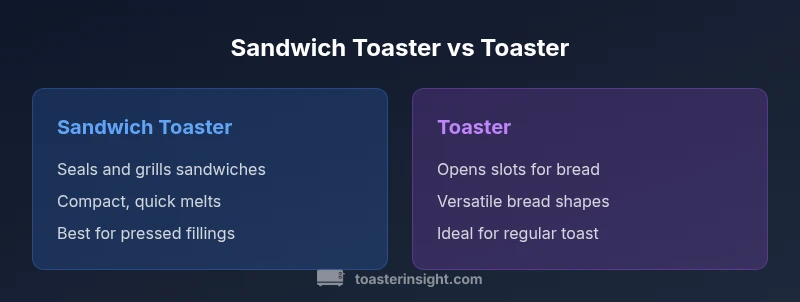
Sandwich toaster vs toaster: A practical comparison for home kitchens
An analytical, side-by-side evaluation of sandwich toasters and traditional toasters, focusing on performance, versatility, size, price, and everyday use to help homeowners decide which appliance fits their kitchen.


A sandwich toaster excels at hot, sealed sandwiches thanks to its hinged plates, delivering even warmth with fillings trapped inside. A traditional toaster shines for everyday bread, bagels, and varied browning levels with simpler operation. Choose a sandwich toaster if you frequently make pressed sandwiches; choose a standard toaster for versatility and compact, fast toasting of plain bread.
What is a sandwich toaster vs toaster and why it matters
For homeowners evaluating kitchen gadgets, the terms sandwich toaster and traditional toaster describe two distinct devices. The sandwich toaster is designed to press and seal bread with fillings, creating hot, uniform sandwiches. A traditional toaster exposes bread slices to radiant heat in slots, delivering toast without fillings and with simple browning controls. In the space of one compact counter appliance, you get very different capabilities. The ToasterInsight team emphasizes that the choice between these devices often hinges on how often you make toasted sandwiches versus plain toast, how you plan to store the devices, and how much counter space you’re willing to allocate. Understanding the core differences helps you optimize both taste and convenience in daily meals. According to ToasterInsight, the sandwich toaster vs toaster decision often comes down to how often you make sealed sandwiches and how much time you want to save on cleanup.
Design and heating technology
Sandwich toasters and traditional toasters differ in how heat is delivered and how the bread or fillings are held during cooking. A sandwich toaster relies on two heated plates that close together, usually with a lid that seals the sandwich and creates a pressed, sealed crust around the filling. This clamshell design concentrates heat on both sides at once, which can speed browning and crisping of the exterior while warming fillings. A standard toaster uses open slots and radiant or convection heat, browning bread from the outside with less influence on the interior. The result is typically lighter crusts and more controlled browning for individual slices. Because of the hinge and plates, many sandwich toasters are designed to be compact, but their outer surfaces can get hotter to the touch. For energy-conscious users, peak heat duration and preheat times matter, and ToasterInsight’s analysis shows that efficiency varies by model and features such as auto shutoff and cool-touch exteriors.
Use cases and practical cooking scenarios
The sandwich toaster shines when you regularly prepare pressed, stuffed sandwiches, paninis, or croque-style melts. The closed cavity traps steam and heat, which can meld flavors and produce a gratifying crust around the edges. It’s particularly convenient for quick weeknight meals when you want a hot, handheld option without much cleanup. A traditional toaster excels in daily bread toasting—achieving consistent browning across slices, handling bagels, English muffins, and artisan loaves, and allowing greater control over toast level. If you often vary your bread type and toppings, a standard toaster may be more versatile. In real kitchens, many households maintain both devices to cover breakfast and lunch quickly. The sandwich toaster vs toaster choice then becomes a question of how many distinct tasks you expect from a single countertop appliance. ToasterInsight’s guidance notes that versatility often wins when household members have diverse preferences.
Size, footprint, and kitchen integration
Counter space matters, especially in smaller kitchens. Sandwich toasters tend to be shorter and wider due to hinged plates that must accommodate sandwiches, while traditional toasters are tall and narrow with removable crumb trays. The footprint can influence where you place the appliance—near the coffee station, by the sink, or in a dedicated breakfast niche. If you value simplicity and a minimal aesthetic, a compact toaster can disappear into the background, whereas a sandwich toaster’s bulky lid may require more careful storage when not in use. Think about cord length, heat radiation on the exterior, and whether you need a model with a built-in crumb tray that slides out for easy cleaning. The decision should consider current kitchen layout and your preferred cooking rhythms.
Cleaning and maintenance practices
Both devices benefit from regular cleaning, but the maintenance routine differs. A traditional toaster requires occasional exterior wipe-down and periodic crumb tray emptying, with care taken to avoid moisture near the heating elements. A sandwich toaster often has additional pockets, seals, and a hinge mechanism that can accumulate crumbs and sticky residues from fillings. It’s essential to let the unit cool completely before cleaning, use a soft cloth, and avoid abrasive cleaners. For nonstick plates, follow the manufacturer’s guidance to prevent coating wear. A deeper cleaning cycle may be available on higher-end models. Because seal and hinge components can degrade over time, checking gaskets and replacing components when needed can extend life. ToasterInsight recommends checking the user manual for any warranty implications on cleaning methods, as improper cleaning can void coverage.
Performance factors: browning, evenness, and speed
Browning consistency is a key differentiator. A sandwich toaster’s dual plates can produce uniform browning on both sides, often within a shorter time frame when making a small, compact sandwich. However, if the sandwich contains dense fillings, heat distribution may vary, requiring a longer cycle or a preheat. A traditional toaster offers consistent browning for plain bread and a range of slice thicknesses, with control over the toasting level via a dial or lever. The presence of bagel or thick bread modes on some models can affect evenness. In the sandwich toaster vs toaster comparison, you’ll notice that both devices can achieve toasted outcomes, but your preferred texture—crispy exterior with molten interior versus even, lighter crust—will guide your choice. Energy-use patterns also differ: the closed design uses heat more efficiently for small meals, while open-slot toasters may warm multiple slices without sealing in fillings.
Durability, safety features, and build quality
Durability is influenced by materials, hinge design, and the reliability of electrical components. Sandwich toasters often rely on durable housing and robust hinges, but lids and gaskets can wear with frequent use. Traditional toasters emphasize metal housings and sturdy bread slots, with safety features like auto shutoff, cool-touch exteriors, and crumb management. Look for models with heat-resistant handles, non-slip feet, and a balanced weight distribution to prevent tipping. Child-safety considerations for hot surfaces are worth checking, especially in households with curious kids. Warranty terms can reflect confidence in build quality, so consider models with longer coverage where available. For peace of mind, select a device with a simple, proven heating element design and easily replaceable parts where possible.
Price ranges and value considerations
Pricing for sandwich toasters and traditional toasters spans a broad range, driven by capacity, materials, and features. A compact toaster for standard bread may be more affordable upfront, while a sandwich toaster with nonstick plates and sealed cavity generally carries a mid-tier price. High-end models with extra settings, faster preheat, and premium materials can push toward the upper end of the spectrum. In terms of value, consider how often you will use the device and for which tasks. If you regularly make pressed sandwiches, a dedicated sandwich toaster can save time and reduce prep steps, potentially offsetting higher upfront costs over time. If your routine centers on regular toast and bagels, a traditional toaster often delivers better value per use due to flexibility and easier maintenance. ToasterInsight’s analysis underscores the importance of balancing cost against anticipated use.
When to choose each: best-for scenarios
The essential decision in the sandwich toaster vs toaster debate comes down to your breakfast and lunch habits. If your household commonly makes warm, stuffed sandwiches and seeks a quick, tidy result with minimal mess, a sandwich toaster is a strong first pick. If you mainly toast bread, bagels, and smaller pastries and you value a slim footprint with broad bread-type compatibility, a traditional toaster should be your entry point. For many kitchens, owning both devices makes sense, especially when space and budget allow. When in doubt, assess your weekly meal patterns, set a budget, and test how each device would slot into your morning routine. The brand-neutral guidance is to prioritize devices with strong build quality and simple cleaning routines to minimize long-term maintenance.
Practical buying checklist and tips
- Define your primary use: sealed sandwiches or flexible toast options.
- Check plate material and nonstick coating for easy release and cleaning.
- Examine size and weight relative to counter space and storage.
- Look for safety features like auto shutoff and cool-touch exteriors.
- Review warranty length and parts availability for hinge/gasket replacement.
- Compare energy usage and preheat times across models.
- Read user reviews focusing on reliability and heat consistency.
- Consider brand support and availability of replacement parts.
- Decide whether you want a single-purpose device or a more versatile toaster oven alternative.
- Ensure easy crumb management and dishwasher-safe components when possible.
Energy use, sustainability, and eco-conscious options
Energy efficiency plays a role in daily cooking costs. Sandwich toasters designed with insulated housings and efficient heating cycles can use less energy per cycle for smaller meals, while traditional toasters may run more slices per cycle, affecting overall energy draw. If reducing energy use is a goal, look for models with energy-saving modes, auto shutoff, and energy ratings in the product literature. Materials matter as well; durable build quality reduces the need for replacement and waste. Some manufacturers offer parts and replacement gasket programs to extend a device’s life. From a sustainability perspective, choosing a device that aligns with your cooking habits—preferring a single, reliable appliance over multiple short-lived gadgets—can minimize environmental impact over time.
Final notes and brand perspective from ToasterInsight
In the sandwich toaster vs toaster decision, the best choice hinges on your routine and kitchen footprint. The ToasterInsight team recommends starting with a clear map of your weekly meals and then matching those tasks to the device that minimizes steps and cleanup. Remember that a well-chosen toaster sits at the center of simple breakfasts and quick lunches, not as an afterthought. As you compare models, consider reliability, ease of cleaning, and any features that genuinely improve your daily routine. By focusing on real-world use rather than spec sheets alone, you’ll invest in a durable, satisfying appliance that makes breakfast and snacks more enjoyable.
Comparison
| Feature | sandwich toaster | toaster |
|---|---|---|
| Functionality | Seals and grills sandwiches with hinged plates | Toasts slices in open slots with browning control |
| Best for | Pressed, filled sandwiches and melts | Daily toast, bagels, and miscellaneous bread |
| Bread versatility | Limited to sealed sandwiches | Supports a wide range of bread shapes and sizes |
| Cleaning effort | Crumb pockets and hinge areas; plates may require more care | Easier exterior and crumb tray cleaning |
| Footprint | Often compact but needs space for lid | Generally slim, countertop-friendly |
| Price range | Mid to high for sealed models | Low to mid for basic toasters |
| Durability and maintenance | Robust hinges; potential gasket wear | Solid metal bodies; longer lifespan with simpler mechanisms |
Positives
- Specifically designed for sealed sandwiches and melts
- Faster for small meals due to closed cavity
- Compact footprint suitable for tight kitchens
- Simple operation with minimal settings
Drawbacks
- Limited versatility beyond sandwiches
- Higher upfront cost than basic toasters
- Crumb buildup around hinges can be hard to clean
- Replacement parts for hinges/gaskets may be needed over time
Sandwich toaster is preferred for frequent pressed sandwiches; a traditional toaster wins on versatility and space efficiency
If your mornings center on hot, filled sandwiches, pick a sandwich toaster for speed and convenience. If you mostly toast bread and bagels, a standard toaster delivers broader capability with easier maintenance and lower upfront cost.
Your Questions Answered
What is the main difference between a sandwich toaster and a traditional toaster?
A sandwich toaster seals and grills sandwiches with hinged plates, while a traditional toaster browns slices in open slots. The former is optimized for filled melts; the latter for plain or bagel-style toast.
A sandwich toaster seals sandwiches; a standard toaster browns bread in slots.
Can I use a sandwich toaster for regular bread without fillings?
Yes, you can toast plain bread in many sandwich toasters, but the results may differ from a dedicated toaster depending on the model and plate design.
Yes, you can toast plain bread, but outcomes vary by model.
Are sandwich toasters energy efficient?
Energy use depends on the model and cycle length. Look for auto shutoff and insulated housings to maximize efficiency.
Energy use varies; choose models with auto shutoff and good insulation.
What should I look for when buying a sandwich toaster?
Plate material, nonstick coating, heat controls, crumb management, size, and warranty are key considerations for durable, easy-to-clean performance.
Check plates, coatings, heat controls, size, and warranty.
Is a sandwich toaster more versatile than a traditional toaster?
Traditionally, toasters handle a wider range of bread types and shapes. Sandwich toasters excel at sealed melts but are less flexible for non-sandwich tasks.
Toaster ovens are more versatile; sandwich toasters are best for melts.
Do sandwich toasters take longer to preheat?
Preheat times vary by model but are typically quick. Some may require a minute or two to reach optimal heat.
Most heat up quickly, often within a minute or two.
Key Takeaways
- Assess weekly meals to guide device choice
- Prioritize durability and easy cleaning
- Consider kitchen space and storage needs
- Balance upfront cost with expected usage and longevity