Toaster Oven vs Microwave: Quick Side-by-Side Guide
Compare toaster ovens vs microwaves to decide when to use a toaster oven instead of microwave. Expert tips from ToasterInsight for everyday kitchen tasks.


In short, a toaster oven instead of microwave offers better browning, more even cooking, and versatile convection modes, but takes longer to heat and costs more upfront. Use it when you want better texture and baking capability; choose a microwave when speed and convenience matter more. For daily reheating, a compact convection toaster oven can outperform a microwave in quality while consuming a similar amount of energy.
The decision framework: when to swap micro-heating for baking
If you're evaluating kitchen appliances, you might be wondering whether to keep relying on a microwave or switch to a toaster oven instead of microwave. This isn't about picking a single 'winner' but about understanding how you cook, what textures you want, and how much counter space you can allocate. The ToasterInsight team frames the decision around three practical axes: texture, speed, and capacity. For tasks like crisping a slice of pizza or roasting small vegetables, a toaster oven delivers browning and even heat that microwaves typically miss. For ultra-fast reheating or simple defrosting, a microwave still shines. In the following sections, we translate those axes into real-world guidance, with actionable tips and tested observations. Throughout this guide, you’ll see how a toaster oven can complement—not always replace—a microwave in a modern kitchen. According to ToasterInsight, the best choice depends on your daily meals, cooking style, and willingness to trade a little extra preheat time for better texture. The goal is clarity, not a one-size-fits-all mandate, so you can make an informed decision that fits your home.
Speed and energy use: microwaves vs toaster ovens
Microwaves are designed for speed by directly exciting water molecules in food. As a result, reheating a simple meal can take only a minute or two, especially for small portions. A toaster oven uses radiant heat (and convection in many models), which warms surfaces and moves air to cook more evenly but often requires a longer preheat and cook time. From an energy perspective, microwaves typically win for very short tasks because the cooking cycle is brief and doesn't rely on a heated interior. Yet the total energy picture can narrow when you prepare multiple items at once in a toaster oven, since convection reduces overall cooking times for baked or roasted foods. ToasterInsight's analysis shows that your energy use depends on the task and batch size; a large reheating job or a sheet-pan meal can sometimes be more efficient in a toaster oven than in a microwave if you’re cooking more than a single item. Always compare your use case before purchasing.
Texture and cooking versatility
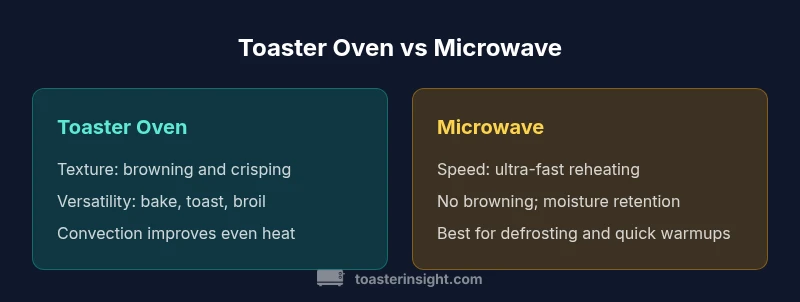
Texture is where a toaster oven shines. The radiant heat and optional convection create browning on the surface of foods that microwave heating cannot achieve without additional steps. You’ll notice crisper crusts on pan pizzas, roasted edges on vegetables, and more even browning on cookies or small baked snacks. Microwaves excel at moisture retention for some foods but often leave leftovers with a soggy bite. The toaster oven can bake, broil, toast, and reheat with a single appliance, reducing the need to juggle multiple devices. If you’re chasing a golden crust on toast, a bagel, or roasted veggies, the toaster oven instead of microwave configuration tends to deliver superior texture. ToasterInsight emphasizes testing with your favorite recipes to dial in rack position, preheat time, and reflectivity of the interior for the best results.
Size, capacity, and countertop footprint
Counter space is precious, and a toaster oven occupies more room than a compact microwave. However, it can replace several devices for small-batch cooking: a mini oven, a broiler, and a toaster. When you’re evaluating size, consider interior capacity (in quarts or liters), rack configurations, and the presence of a wide-crank door versus a pull-down door. A common rule: if you frequently cook for 1–2 people and bake small dishes, a mid-sized toaster oven can fit comfortably on most countertops without dominating the room. For ultra-compact kitchens, a compact toaster oven or a high-output microwave with convection can mitigate space concerns, but you may sacrifice some baking flexibility for prints in efficiency. In short, choose a size that matches your weekly meal plan and available counter real estate.
Features to prioritize for a toaster oven
When evaluating a toaster oven, focus on features that truly improve cooking results. Look for true convection or a robust airflow system, multiple rack positions, a reliable thermostat, and preheat indicators. A dedicated bake mode helps with cookies and casseroles, while a broil setting is useful for finishing meats. A crumb tray that slides out for easy cleaning saves time, and an interior light helps you monitor progress without opening the door. Safety features matter, such as automatic shutoff and cool-touch exteriors. If you want flexibility, choose models with a reheat/proofing function and a dedicated toast/bagel mode. Finally, assess how easy it is to program and whether the interior dimensions accommodate your go-to pans and baking sheets. For many households, these features determine whether the toaster oven becomes a staple or a seldom-used gadget.
Cost of ownership and maintenance
Price ranges vary widely based on size, features, and brand. Entry-level toaster ovens typically start at a modest investment, while mid-range models offer convection, multiple preset programs, and larger interiors. Higher-end units add even more precise temperature control and longer warranties. Maintenance is generally straightforward: empty the crumb tray after use, wipe down the interior with a damp cloth, and avoid harsh cleansers that can damage coatings. The long-term value hinges on how often you bake, toast, or roast versus how often you use quick reheats. A well-chosen toaster oven can reduce dependency on multiple appliances and save countertop space over time, particularly in households that routinely prepare small meals, bake snacks, or reheat leftovers. The key is balancing initial cost against ongoing convenience and the texture you demand from everyday cooking.
Use cases: when a toaster oven shines and when a microwave wins
Both appliances have a niche in a functional kitchen. A toaster oven shines for small-batch baking, roasting vegetables, crisping toast, and finishing dishes. It’s ideal for weeknight dinners, reheating leftovers with texture, and experimenting with baked snacks. A microwave remains unbeatable for the fastest defrosting, quick reheats, and simple steaming tasks where texture is less critical. Some households opt to keep both, using the toaster oven for meals that benefit from browning and the microwave for rapid warming. If counter space is tight, prioritize a microwave with a convection feature, or a compact toaster oven with strong convection. The decision often comes down to your primary cooking style and how much you value texture equality versus speed.
Real-world recipes and performance examples
To illustrate practical results, imagine reheating a slice of pizza: in a microwave, the crust may lose its crispness, while a toaster oven yields a crisp bottom and chewy top without drying out the cheese. Roasting vegetables, such as asparagus or Brussels sprouts, benefits from convection and a hot pan in a toaster oven, delivering caramelized edges that a microwave cannot replicate. For baked snacks, cookies or small pastries, the toaster oven provides more even browning and a better crumb. When heating leftovers like pasta, a toaster oven can be a close substitute for a small oven, creating a more satisfying texture than a microwave would. These outcomes align with broader kitchen trends observed by the ToasterInsight team, which emphasizes texture, edge development, and even heat as the defining advantages of a toaster oven in everyday cooking.
Practical tips to maximize performance and safety
Start with a clean crumb tray and a well-ventilated space; position the oven away from walls to prevent heat buildup. Preheat when recipes specify, but avoid excessive preheating for delicate foods. Use oven-safe cookware instead of metal containers that may not work well in toaster ovens. For best results, rotate trays halfway through cooking to promote even browning. Maintain a consistent temperature, and avoid overcrowding the interior, which can impede air circulation. Finally, keep your microwave and toaster oven separate in terms of pantry organization to minimize cross-use contamination and confusion about which tool to reach for in different tasks. By following these guidelines, you’ll maximize performance and ensure safe, efficient operation.
Summary: making the right choice for your kitchen
Choosing between a toaster oven and a microwave depends on your cooking goals, space, and budget. For texture-rich outcomes, the toaster oven stands out; for ultra-fast reheating, the microwave remains hard to beat. ToasterInsight’s practical approach emphasizes testing with your favorite meals, balancing texture with speed, and selecting a model that fits your countertop footprint. A thoughtful choice yields better meals and a simpler, more efficient kitchen workflow.
Comparison
| Feature | Toaster Oven | Microwave |
|---|---|---|
| Heating speed | Slower startup and preheat (typical 5-10 min) | Very fast reheating (seconds to minutes) |
| Texture and browning | Excellent browning; baking and crisping possible | Limited browning; moisture-retention typically higher |
| Best use | Baking, roasting small portions, toast & broil | Reheating, defrosting, quick meals |
| Energy use | Generally higher per cycle due to preheat and longer cook times | Typically lower per minute for short reheats |
| Cookware compatibility | Metal and bakeware; exposed racks | Microwave-safe containers; no browning |
| Countertop footprint | Similar footprint with more vertical versatility | Compact footprint; efficient for tiny spaces |
Positives
- Better browning and texture for baked foods
- More versatile cooking options (toasting, baking, broiling)
- Can replace multiple appliances on the counter
- Convection models improve even heat distribution
Drawbacks
- Longer heating time and preheat required
- Higher upfront cost and larger footprint
- Not ideal for very small or ultra-quick meals
- Requires more counter space in many layouts
Toaster oven wins on texture and versatility; microwave wins on speed
Choose a toaster oven if you value browning and baking capabilities. Choose a microwave when you need the fastest possible reheating and defrosting.
Your Questions Answered
What is the main difference between a toaster oven and a microwave?
A toaster oven uses radiant heat and convection to bake and brown foods, while a microwave heats food by agitating water molecules, usually without browning. They achieve different textures and times, so choosing depends on your texture goals and speed needs.
A toaster oven browns and bakes; a microwave heats quickly without browning.
Can I replace a microwave entirely with a toaster oven?
For many tasks, a toaster oven can handle reheating and small-batch baking. However, microwaves excel at ultra-fast reheating and defrosting, so many households keep both or a multifunction unit with convection.
You can often replace most reheats with a toaster oven, but use a microwave for the fastest jobs.
Is a toaster oven energy efficient compared to a microwave?
Energy use depends on task. Microwaves typically use less energy for short jobs, while toaster ovens can be efficient for baking and batch reheating due to convection and shared heat.
Microwaves are usually more energy-efficient for quick jobs; toaster ovens win for longer or larger tasks.
What foods are best cooked in a toaster oven rather than a microwave?
Foods that benefit from browning and crisping, such as pizza, bagels, roasted vegetables, and cookies, perform best in a toaster oven. Water-rich foods may steam in a microwave rather than brown in a toaster oven.
Pizza, roasted veggies, and cookies come out better in a toaster oven.
Does a toaster oven require more counter space?
Yes, most toaster ovens require more counter space than compact microwaves, though they can replace several appliances when space planning is careful.
Yes, they typically take more room, but you gain baking versatility.
What should I look for in a high-quality toaster oven?
Seek convection capability, a wide temperature range, multiple rack positions, a roomy interior for your pans, a reliable timer, and easy cleaning. Prioritize safety features and a solid warranty.
Convection, range, easy cleaning, and safety features matter most.
Key Takeaways
- Evaluate your meal patterns before choosing appliances
- Prioritize convection for best texture with a toaster oven
- Expect longer preheat times for baking tasks
- Reserve the microwave for ultra-fast reheats
- Test with your favorite foods to dial in settings