Convection Toaster Oven vs Toaster Oven: Which Is Best for Your Kitchen?
An objective, in-depth comparison of convection toaster ovens vs standard toaster ovens, covering performance, energy use, features, and best-use scenarios for home cooks.


Convection toaster ovens typically outperform standard toaster ovens for baking and roasting due to a fan and exhaust that circulate hot air. The main trade-offs are cost, size, and potential drying or uneven browning for very delicate items. In short: choose convection for versatility and speed; choose a standard toaster oven for simplicity and affordability.
What convection adds to toaster ovens
When comparing a convection toaster oven vs toaster oven, the defining feature is a built-in fan and a vent system that circulate hot air around the food. This changes heat transfer from primarily radiant convection to convective heating, which can lead to more even browning and faster cooking in many scenarios. Home cooks often discover that convection excels for cookies, roasted vegetables, and meats because the moving air helps dry surfaces to a crisp finish while keeping the interior moist. The ToasterInsight team notes that the primary value of convection is versatility: you can bias the oven toward baking, roasting, or broiling with minimal protocol changes. That said, the fan adds complexity—more parts to service and occasional noise—so the decision hinges on how frequently you bake or roast rather than how often you simply toast. In brief, convection toaster oven vs toaster oven boils down to your cooking repertoire and tolerance for minor maintenance.
Core differences: convection vs standard
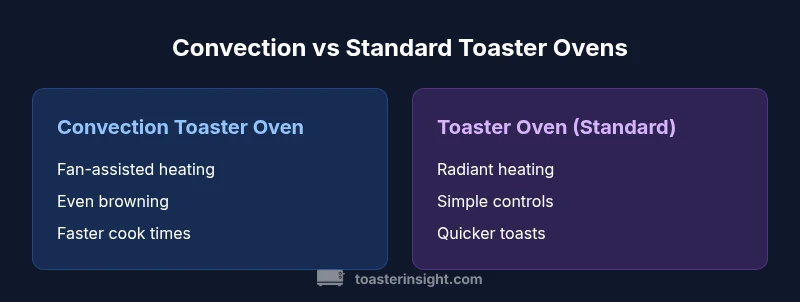
The most visible difference between convection toaster ovens and standard models is the heat distribution mechanism. A convection model uses a small fan and exhaust to move heated air, delivering more uniform heat and better browning on many foods. Traditional toaster ovens rely on radiant coils and a static air pocket inside the chamber. This usually means stronger bottom browning on simple toasting tasks and less even results when baking items like cookies or pastries. Temperature control tends to be more precise on higher-end convection units, but cheaper models may exhibit hotspots if airflow is constrained. Size and interior layout also vary: convection ovens frequently house slightly larger fans and ducts, which can marginally reduce usable interior space. When selecting between the two, map your typical dishes—baked goods, sheet-pan meals, and roasted proteins favor convection; light toasting and quick reheats are often well-served by standard models.
Real-world cooking scenarios: baking, toasting, roasting
In real kitchens, the convection toaster oven vs toaster oven debate becomes practical when you run through common tasks. For high-volume baking, convection yields more even texture and faster finish times, with cookies browning evenly on multiple racks and pastries developing a uniform crust. Roasting vegetables like carrots, peppers, and Brussels sprouts often benefits from the airflow, which promotes caramelization on the exterior. Meats can emerge with a crisp exterior while retaining juiciness inside when convection is engaged. Toasting bread slices remains effective in both, but convection helps minimize soggy bottoms and promote a consistent browning pattern. For casual weeknight meals, a standard toaster oven can reach the finish line with less fan noise and simpler controls. This practical contrast makes it clear that the convection toaster oven vs toaster oven decision should align with your cooking calendar and preferred textures.
Temperature control and hot air distribution
Convection toasters emphasize a more uniform heat profile due to air movement. The circulating air reduces temperature stratification, so pan placement matters less than in radiantly heated ovens. However, airflow can occasionally cause delicate items like flaky pastries to shift if racks are not properly positioned or if the food is crowded. In standard toaster ovens, heat comes primarily from top and bottom coils with little airflow, which can lead to hotspots and uneven browning if the food is crowded. The takeaway is to use proper rack placement and avoid overcrowding in both types; with convection, you may need to rotate trays for extremely delicate or layered items. For most cooks, the trade-off is worth it for more consistent results and expanded capabilities.
Preheating and time-to-cook dynamics
Preheating times in convection models often run shorter because the fan starts circulating air sooner and helps bring the chamber to the target temperature faster. That means you may see a noticeable reduction in overall cooking time, especially for sheet-pan meals and casseroles. In contrast, standard toaster ovens might require longer preheats and bake times to achieve similar browning and texture on the same dish. The practical effect is that, for busy households, convection can reduce total cooking time, freeing up the oven for additional tasks. Yet the improved speed sometimes comes with a slight risk of over-browning if you leave food unattended. Beginners should start with recommended settings from the user manual and adjust after a couple of batches.
Energy efficiency & cost of ownership
Energy efficiency in kitchen appliances is often framed by cooking time and temperature accuracy. Convection toaster ovens typically save energy by shortening cooking times and allowing lower temperatures for certain recipes, but this depends on model design and how you use the appliance. Standard toaster ovens may cost less upfront but can require longer cook cycles for the same results, which can offset initial savings. Over the long term, the best value hinges on your overall cooking load, preferred textures, and willingness to tolerate fan noise. ToasterInsight analysis suggests focusing on units with well-sealed doors, reliable temperature control, and good airflow paths to maximize energy efficiency while minimizing maintenance complexity.
Maintenance, cleaning, and longevity
Maintenance considerations differ between convection and standard models mainly due to the fan and air pathways in convection units. The fan and ducts can accumulate dust and grease if you cook greasy foods frequently, so regular cleaning is advised. Use the included brush attachment or a soft cloth to remove debris from vents and the interior surfaces. With standard models, cleaning focuses mainly on removing crumbs and maintaining door seals. Regardless of type, avoid using abrasive cleaners or harsh solvents on nonstick surfaces. A consistent cleaning schedule helps preserve performance and extend the life of seals, gaskets, and interior coatings. Over time, the difference in maintenance simplicity may influence your long-term satisfaction with either option.
Use-case profiles: best for households and cooks
For households that bake weekly and want reliable sheet-pan results, a convection toaster oven shines. It can act as a secondary oven, expanding cooking capacity without heating up a full-size oven. Casual cooks or apartment dwellers who prioritize quick snacks and compact footprint may prefer a standard toaster oven for its simplicity and lower upfront cost. In multi-person households or small kitchens, balancing performance with space is crucial: if you frequently bake pastries or roast vegetables, convection is worth the extra investment; if you mostly reheat leftovers and toast bread, a standard model will suffice. The ideal choice depends on your menu and how much you value speed, texture, and appliance footprint.
The buying decision: features vs budget vs space
When deciding between convection toaster oven vs toaster oven, consider three core factors: cooking repertoire, space, and power availability. If you regularly bake, roast, or broil, and you have room for a larger model with robust airflow, a convection unit offers greater flexibility and faster results. If your needs are simple: quick toasting, rewarming, and small meals, and you want lower upfront cost, a standard toaster oven remains a sensible option. Regardless of choice, prioritize features such as precise temperature control, even heat distribution, a durable door seal, easy cleaning, and consistent performance across multiple rack positions. By mapping your weekly menus to the hardware, you’ll identify the right balance between a feature-rich convection toaster oven and a straightforward toaster oven.
Comparison
| Feature | Convection toaster oven | Toaster oven |
|---|---|---|
| Heat source | Fan-assisted convection | Radiant heating elements |
| Air circulation | Active airflow circulating heat | Limited or no forced air |
| Browning/evenness | Superior browning and even texture | Good browning but less uniform for bake items |
| Cooking speed | Often faster due to convection | Typically slower without convection |
| Interior capacity | Similar footprint; varies by model | Often compact interior with fewer racks |
| Energy efficiency | Often more energy-efficient due to shorter times | May require longer cycles in some models |
| Price range | Mid-to-high price range | Budget to mid-range |
| Best for | Baking, roasting, and versatile cooking | Simple toasting and quick reheats |
Positives
- Faster, more even browning for many foods
- More versatile for baking and roasting
- Can double as a second oven in small kitchens
- Potential energy savings over longer bake cycles
Drawbacks
- Higher upfront cost than standard models
- Louder due to the fan and venting
- More components to clean and maintain
- Can be unnecessary for light toasting tasks
Convection toaster ovens generally win on versatility and speed; standard toaster ovens win on simplicity and cost.
If you bake or roast regularly, convection is the better long-term investment. If you mainly reheat and toast, a standard model keeps things simple and affordable.
Your Questions Answered
What is convection toaster oven and how does it differ from a regular toaster oven?
A convection toaster oven uses a small fan and vent to circulate hot air, delivering more even heat and faster cooking. A regular toaster oven relies on radiant coils without active air movement, which can lead to hotter spots but simpler operation. The choice depends on your cooking goals and tolerance for noise or maintenance.
Convection ovens move air for even cooking, while standard ovens do not. If you bake often, convection helps; if you only toast, a regular model may be enough.
Is convection toaster oven worth it for casual cooks?
For casual cooks, convection offers better flexibility for snacks, reheats, and simple baking. If you rarely bake or roast, a standard toaster oven may be more cost-effective and easier to operate.
If you bake occasionally, convection adds value; otherwise, a basic model may suffice.
Can I bake bread or cookies in a toaster oven?
Yes, you can bake bread and cookies in either type, but convection often yields more even browning and a crisper crust. You may need to adjust rack position and monitor closely to avoid over-browning.
Bread and cookies bake well in convection ovens with careful rack placement.
Do convection toaster ovens require special cookware?
Most standard bakeware works in convection models, but avoid overly large or nonstick pans that block airflow. Heavier, oven-safe sheets and proper rack spacing help optimize convection results.
Stick to standard bakeware and keep airflow clear for best results.
How do I clean and maintain a convection toaster oven?
Regular cleaning involves removing crumbs, cleaning the door seals, and wiping interior surfaces. Pay attention to the fan housing if accessible and follow the manufacturer’s cleaning guidelines to avoid damaging components.
Clean crumbs, check seals, and follow the manual for best results.
What features matter most when buying a convection toaster oven?
Prioritize even heat distribution, precise temperature control, reliable door seals, multiple rack positions, and a design that minimizes fan noise. Also consider size, interior capacity, and ease of cleaning.
Look for even heat, precise control, and easy cleaning.
Key Takeaways
- Assess your typical cooking tasks to choose convection vs standard.
- Consider space, power, and model size before buying.
- Leverage convection for baking and roasting versatility.
- Budget for upfront cost and potential maintenance needs.
- Rotate pans as needed to maximize even browning.