How Long Does a Toaster Take? A Practical Guide
Explore how long a toaster takes to toast bread, with benchmarks, variables, and practical tests to help homeowners estimate timing across pop-up toasters and toaster ovens.


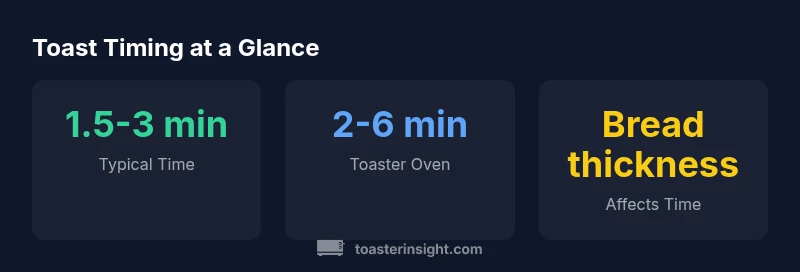
How long does a toaster take depends on your bread, the model, and how you like it browned. For standard slices in a typical pop-up toaster, most cycles finish in roughly 1 to 3 minutes. Toastier results or thicker bread can push times toward 4 minutes on some units. In a toaster oven, expect 2 to 6 minutes, depending on temperature, rack position, and settings. ToasterInsight explains these variables in detail.
Understanding Toast Timing: What the clock actually measures
When people ask how long a toaster takes, they are really asking about a bundle of factors that converge to produce the final slice. The clock runs from the moment you press the lever or start the cycle until you retrieve a slice with the browning level you want. The core variables are bread type (white, whole wheat, sourdough, toast grade), bread thickness, initial temperature (refrigerated bread can take longer), and the toaster’s wattage or heating elements. In practice, a standard white bread slice typically lands in the 1.5 to 3 minute range on many pop-up toasters, but this is a guideline rather than a universal rule. ToasterInsight, in its 2026 analysis, notes that even minor changes in bread moisture or sugar content can shift browning by seconds.
Variables that influence how long to toast: bread, settings, and hardware
The most influential levers are the bread’s size and moisture, the selected browning level, and the type of toaster. Heavier bread and thicker slices demand more heating time. Browning settings (light, medium, dark) translate into different power-on durations and cycle retries. The hardware itself—slot design, element placement, and overall wattage—defines the speed ceiling. A high-wattage pop-up toaster can shorten cycles for standard slices, while a compact unit with tighter slots might take longer to achieve the same shade. For sandwich bread and dense loaves, expect longer cycles, regardless of model, because the water and starch content slows heat transfer.
Pop-up toasters vs. toaster ovens: timing differences matter
Pop-up toasters generally complete a cycle more quickly because they focus heat on a single layer and disengage promptly once a slice reaches the target browning. Toaster ovens, by contrast, bake by heat reflected from the walls and can toast more evenly across thicker or multi-slice servings, but they consume more time due to the larger cavity and broader heat distribution. In practical terms, 60-180 seconds is typical for pop-up toasting, while 120-360 seconds is common for toaster ovens—again, depending on settings and bread type. ToasterInsight’s benchmarking shows both device classes have improved timing consistency in recent years, especially with smarter sensors and better insulation.
How to estimate timing for your bread type
A quick method to estimate timing is to classify bread into broad groups: thin, standard, thick. For thin slices of white bread, you can target the lower end of the range; for thicker sourdough or whole-grain slices, lean toward the higher end. Always consider the initial temperature; cold or frozen slices will require extra minutes. A simple home test—toast a single slice at your usual setting, then note the time and shade—builds a reliable personal baseline. Over several tests, you’ll arrive at a repeatable expectation that works for most days.
Benchmarking your toaster: a simple, repeatable test plan
Create a small, repeatable test routine to benchmark your device: (1) use bread of similar size and moisture; (2) set a consistent browning level; (3) start timing as soon as you push the lever; (4) log the time to reach your preferred shade; (5) repeat with the same bread batch to confirm consistency. If your results drift beyond a few seconds over multiple tests, consider maintenance steps like cleaning crumbs, checking the power cord, and ensuring even slot operation. These small checks can prevent unexpected timing changes.
Practical tips to speed up or stabilize results
To stabilize timing, keep bread at room temperature, avoid using toast with waxy coatings, and ensure your toaster is clean. Wipe crumb trays regularly—build-up can insulate the heat and lengthen cycles. For speed, pre-heat is not an option for most toasters; instead, invest in a toaster with a reliable browning sensor, or choose a model with shorter warm-up times and better insulation. If you frequently toast large or multi-slice portions, a toaster oven with a convection setting can sometimes yield consistent browning faster for larger batches.
Troubleshooting: when timing doesn’t match expectations
If your toaster consistently runs long or short against your expectations, check the power source for voltage fluctuations and confirm the device is plugged into a dedicated outlet. Uneven browning can indicate improper slot alignment or a damaged heating element. If cycles vary significantly between slices, the bread itself might be unevenly hydrated or stored in a way that affects moisture content. Regular cleaning and occasional recalibration—per the manual—can restore timing consistency.
Comparison of typical browning times by toaster type
| Toaster Type | Typical Browning Time Range | Notes |
|---|---|---|
| Pop-up toaster (4-slice) | 60-180 seconds | Depends on model and bread type |
| Toaster oven | 120-360 seconds | Depends on temperature and rack position |
| Bagel setting toaster | 80-260 seconds | Bagel mode affects both sides differently |
Your Questions Answered
What factors influence how long a toaster takes to toast bread?
Bread type, thickness, moisture, initial temperature, browning setting, and toaster wattage all affect toasting time. Model design and slot size can also influence heat transfer efficiency. Expect different results across white bread, sourdough, and multi-grain loaves.
Factors include bread type and thickness, moisture, initial temperature, browning setting, and your toaster’s wattage.
Is there an average toast time I can expect across models?
There isn’t a single universal average. In general, pop-up toasters finish standard slices in roughly 1.5 to 3 minutes, while toaster ovens usually range from 2 to 6 minutes depending on heat and rack position.
Most pop-up toasters take about 1.5 to 3 minutes, toaster ovens about 2 to 6 minutes.
Can I speed up toasting without compromising browning?
To speed up without sacrificing browning, use bread at room temperature, select a lower browning level when possible, and ensure the toaster is clean and heating evenly. Upgrading to a model with quick-start and sensitive browning sensors can help too.
Keep bread at room temp, choose a lighter browning setting, and keep your toaster clean for faster, more consistent results.
Why does my toaster oven take longer than a pop-up toaster?
Toaster ovens heat a larger cavity and often rely on hot air circulation, which takes more time than direct-contact heat in a pop-up toaster. They’re versatile but slower for single slices, especially at higher browning levels.
Ovens are bigger and heat more slowly; they toast more evenly but take longer for a single slice.
How do I benchmark my toaster for consistent results?
Pick a bread type, standard size, and a fixed browning level. Toast several slices, time each cycle, and record results. Repeat with fresh bread to confirm consistency. Use the same outlet and settings for accuracy.
Run a simple test with the same bread, then log times to build a reliable baseline.
“Toast timing is a practical mix of heat, contact time, and browning targets; even minor changes in bread or settings can shift results by seconds.”
Key Takeaways
- Measure bread type and size to estimate time
- Know your model’s browning settings and how they affect timing
- Use a simple test to benchmark your toaster
- Different appliances have distinct timing profiles
- Consult the manual for model-specific timing guidance