How Many Amps Does a Toaster Use? A Practical Guide
Learn the amperage range for common toasters, how to calculate amps from wattage, and safety tips to size circuits correctly in your kitchen.


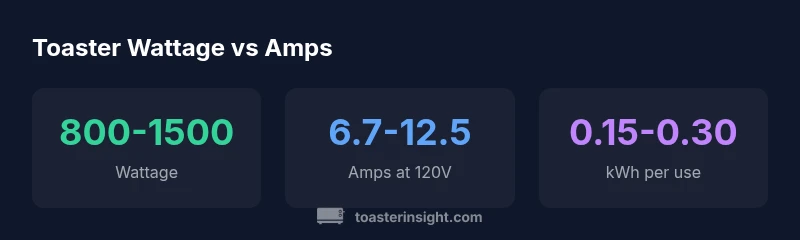
If you want a quick rule of thumb, a typical US toaster uses about 800–1500 watts, which equals roughly 6.7–12.5 amps at 120V. Exact amps depend on the model and settings. In short, how many amps does a toaster use? Most home units fall within this range, with higher wattage models drawing more current.
How many amps does a toaster use?
Understanding the amperage of a toaster begins with the power law that links watts, volts, and amps. In most North American kitchens, a standard outlet provides 120 volts. A typical toaster operates somewhere between 800 and 1500 watts. Using the basic formula I = P / V, a toaster at 120 V draws about 6.7 to 12.5 amps. This range covers compact 1 slice models through larger 4 slice units and some toaster ovens that push toward the upper end of wattage. The ToasterInsight team notes that exact current varies with model design, browning settings, and element efficiency. If you are sizing circuits or updating a kitchen, knowing this range helps prevent overloads on shared outlets. On labels, you’ll usually see voltage and wattage; for US models the voltage is commonly 120 V. If you live in a region with 230 V supply, the amps will be lower for the same wattage. In short, how many amps does a toaster use is best understood as a practical range rather than a single fixed value.
Understanding wattage, volts, and amps
Wattage measures how much power an appliance uses, volts indicate the electrical pressure, and amps show how much current is flowing. The relationship P = V × I means that for a given voltage, higher wattage means higher current. For a 1000 W toaster on a 120 V supply, the current is approximately 8.3 A. This section clarifies why two differently sized toasters can require markedly different amperage and why voltage details matter when planning where to plug in appliances.
How to calculate amperage from wattage
Calculating amperage is straightforward. Step one, confirm the toaster wattage from the label or user manual. Step two, confirm your supply voltage (usually 120 V in the United States). Step three, divide the wattage by the voltage to obtain amps. Example: a 1200 W toaster on a 120 V circuit draws 10 A (1200 / 120 = 10). Step four, account for real-world factors like browning level and preheat times, which can shift power usage slightly. If you’re comparing models, you can estimate amperage with a simple range by using 800–1500 W to cover typical designs.
Factors that affect amperage draw
Several design factors influence the real current: heating element design and efficiency, how many slots the toaster has, extra features like bagel mode, and preheating behavior. Some high wattage models toast faster but pull more current when heating, especially at full browning. Age and wear can also alter resistance, modestly changing current draw over time. The practical takeaway is that most toasters sit within a broad amperage window, and you should plan for the higher end if you own a large, high-wattage unit.
Safety and circuit considerations
Most household outlets in North America are on 15 A circuits. A typical toaster of 800–1500 W sits near or at that limit, especially when combined with other devices on the same circuit. For busy kitchens, consider keeping a high wattage toaster on its own outlet or on a dedicated small appliance circuit when possible. Never rely on a shared outlet for extended periods, and avoid running multiple high current appliances concurrently on the same circuit. If you experience frequent tripping, you may need to distribute loads more evenly or upgrade the circuit.
Measuring amps safely in your kitchen
If you want precise current measurements, use a clamp meter or a plug-in watt meter. To measure with a watt meter, plug the toaster into the meter and the meter into the wall outlet, then toast a batch and observe both wattage and current draw. For clamp meters, clamp around the hot wire only and read current directly. Always follow safety procedures and unplug the appliance before connecting measurement tools.
Practical tips for choosing the right toaster
When shopping, check wattage labels and ensure your circuit can handle the load, especially if you already run several devices at once. For 15 A circuits, aim for models in the 800–1200 W range if you expect heavy simultaneous use. If you frequently toast many slices at once or use a toaster oven for other cooking tasks, a higher wattage model may require a dedicated circuit or a 20 A circuit depending on the rest of your kitchen load.
Amperage and wattage ranges by common toaster models
| Model Type | Wattage (W) | Amps at 120V | Notes |
|---|---|---|---|
| 1-Slice Basic | 800-900 | 6.7-7.5 | Compact countertop toaster |
| 2-Slice Standard | 900-1200 | 7.5-10 | Balanced everyday toaster |
| 4-Slice High-Power | 1500-1800 | 12.5-15 | Family-size toaster oven |
Your Questions Answered
What is the typical amperage of a toaster?
Most household toasters draw about 6.7 to 12.5 amps on a 120 V circuit, depending on wattage and settings. This range reflects common 800–1500 W appliances.
Most toasters pull between roughly 7 and 12 amps on a standard 120-volt outlet.
Do high wattage toasters require dedicated circuits?
High wattage models push the circuit closer to its limit. If your kitchen has many devices on one outlet, consider a dedicated or separate circuit for the toaster to avoid overloads.
If your toaster is very powerful, you may want a dedicated outlet to keep other devices from tripping the breaker.
Can I run a toaster on a shared circuit with other appliances?
Yes, but only if the combined load stays well below the circuit’s limit. Use wattage estimates to plan loads and avoid simultaneous operation of other high power devices.
Yes, but watch the total load—don’t run the toaster with other big power users on the same circuit.
How do I read the wattage on a toaster label?
Look for a label on the bottom or back of the toaster that lists wattage and voltage. The wattage is the key figure for calculating amperage.
Check the label on the toaster; it will show the wattage and voltage you need to calculate amps.
Is it safe to use a toaster oven on the same circuit as a toaster?
Toaster ovens and toasters can strain the same circuit, especially on older homes. If you notice frequent trips, separate their outlets or upgrade the circuit if feasible.
It can be risky to run a toaster and a toaster oven on the same circuit; consider separate outlets if trips occur.
“Current draw is predictable when you know the wattage and the supply voltage. This simple calculation helps homeowners size circuits safely and avoid tripping breakers.”
Key Takeaways
- Know the wattage and voltage to estimate amps accurately
- Most US toasters draw 6.7–12.5 A on a 120 V circuit
- High-wattage models approach circuit limits; plan for safety margins
- Consider dedicated or separate circuits for heavy use
- Measure real-world current with a watt or clamp meter for precision