Comparing Toaster Ovens: A Practical Side-by-Side Guide
An analytical, side-by-side comparison of countertop toaster ovens covering size, power, features, energy use, and value to help homeowners pick the right model.


TL;DR: When comparing toaster ovens, convection and smart features offer the best long-term versatility, while basic models deliver lower upfront cost. For most homes, a mid-sized convection oven with reliable presets hits the sweet spot; if you want automation, choose a smart Wi‑Fi model. For small kitchens or tight budgets, a compact non-convection unit can suffice.
Why Consumers Compare Toaster Ovens
In today’s kitchen decisions, many homeowners find themselves in the realm of comparing toaster ovens to balance space, budget, and cooking needs. According to ToasterInsight, the most valuable insights come from structurally evaluating size, power, and features before delving into brands. The act of comparing toaster ovens is not just about “which model is best” but about identifying where your use case intersects with capability. When you start comparing toaster ovens, you should consider how often you bake, what you bake, and how much counter space you’re willing to devote to an appliance that may replace or supplement a full-size oven. This guide will help you understand the core criteria and how ToasterInsight evaluates them to offer practical recommendations.
The goal of this comparison is to translate feature lists into real-world outcomes—crispy crusts, evenly browned pastries, and reliable performance during weeknights. You’ll see how factors like convection, size, and connectivity affect day-to-day use, so you can optimize your purchase for your kitchen workflow. Throughout, we reference practical benchmarks and typical usage scenarios to keep the math human, not overwhelming.
ToasterInsight analysis shows that the most confident buyers are those who map their cooking tasks to a specific model class—compact, mid-sized convection, or smart-enabled units—rather than chasing every new feature that hits the market.
Key Decision Drivers (Size, Power, and Features)
Choosing between toaster ovens starts with three levers: space, power, and capabilities. First, measure your counter real estate and estimate the largest dish you’ll routinely bake. Most households find that 0.6 to 0.9 cubic feet of cavity space accommodates a couple of baking sheets and a 9-inch pizza, while some premium models reach near 1.0 cubic foot. Second, consider power: toaster ovens typically run on 900 to 1800 watts. If you use the oven for long roasting sessions, a higher-wattage model can meaningfully reduce preheat time, but it will also draw more current when in use. Third, list features that matter most: preset programs (toast, bake, broil, roast), crumb tray accessibility, interior lighting, and, increasingly, smart connectivity. When you map these keys to your daily meals, you’ll begin to separate “nice-to-have” extras from essential capabilities. The “comparing toaster ovens” exercise becomes an exercise in aligning these attributes with your family’s routines and kitchen layout.
This section sets the stage for a practical evaluation framework that can be reused across brands and price tiers. You’ll see how different models trade size for features, how smart controls affect usability, and how to gauge whether a given option truly offers value relative to its price. As you read, keep your core use cases in view: weeknight dinners, weekend baking, breakfast toast, and occasional roasting for family gatherings.
Convection vs Non-Convection: What Matters
A central differentiator in the world of toaster ovens is convection. Convection models use a small fan to circulate hot air, accelerating heat transfer and delivering more even browning. For many foods—roasted vegetables, frozen snacks, and baked pastries—the convection cycle yields more reliable results in less time. Non-convection models rely on radiant heat from elements and can be perfectly adequate for simple tasks like warming and toasting. If your recipes often rely on precise broiling or crisp edges, convection can be a meaningful upgrade. If you primarily reheat leftovers or toast bread, a non-convection unit may be perfectly sufficient and more economical.
From a practical standpoint, the decision to prioritize convection hinges on your cooking frequency and the types of dishes you prepare. A well-designed convection model can reduce preheat times and enable multi-rack baking, improving throughput for busy households. However, some bakers prefer the predictability of radiant heat without the fan, especially when delicate pastries require very gentle heat. In the end, comparing toaster ovens with and without convection helps you identify the right balance of speed, control, and texture for your kitchen style.
Smart Features: Connectivity, Apps, and Safety
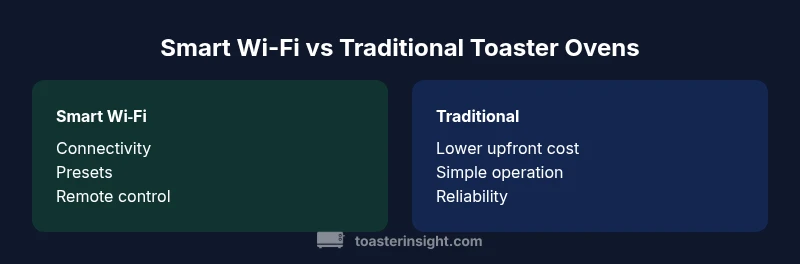
Smart features are increasingly common and can significantly affect daily use. Wi‑Fi connectivity, companion apps, and sensor-based cooking modes offer conveniences like remote preheating, step-by-step programs, and performance insights. For many households, these capabilities translate into consistent results when you’re juggling multiple tasks. On the safety front, smart models often include child-lock features, auto-shutoff, and crash protection for overheating. If you value automation and precision timing, a smart toaster oven can be a strong long-term investment. If you rarely use the advanced modes, a traditional unit with solid performance may be more cost-effective.
When evaluating smart vs traditional, consider how much you’ll rely on presets and whether you want to monitor progress from your phone or voice assistant. It’s also wise to assess software updates and what they mean for reliability over time. A well-supported smart model can extend the useful life of your appliance beyond simple mode toggling by adding new features through updates. In the broader market, you’ll find models with built-in health and safety indicators, automatic cooling fans, and even integration with kitchen ecosystems—features that can differentiate results during “comparing toaster ovens.”
Size and Capacity: How Much Can You Bake?
Capacity is often the most tangible factor for a family or apartment dweller alike. Cavity size translates into how many items you can bake at once and what shapes fit inside. A common benchmark is the ability to accommodate a standard sheet pan or a couple of smaller racks. A typical mid-sized model offers about 0.6 to 0.8 cubic feet of space, enough for a 9-inch pizza or a couple of cookies sheets. Larger units can tackle two racks simultaneously, expanding your repertoire from sheet-pan dinners to multi-dish roasts. If you frequently bake tall items such as casseroles, verify interior height clearance and rack versatility. Compact units are ideal for apartments or second kitchens, where space is limited but you still want the efficiency and control of an oven alternative. In short, when comparing toaster ovens, always confirm physical dimensions, rack options, and whether the unit can handle your everyday meals.
Another practical tip is to think about tray formats and baking sheet sizes you own. If your cookware rarely exceeds a 9x13-inch pan, you can comfortably choose most mid-sized or compact models. If you routinely use larger pans, prioritize models with adjustable racks and a bit more interior height. This helps avoid the frustration of a model that only seems compact in exterior dimensions but can’t hold your favorite bakeware. The goal is to prevent “buyers’ remorse” due to misjudging capacity before you take the unit home.
Price and Value: Budgeting for 2026
Price is often the most immediate barrier, but it’s not the only factor. For comparing toaster ovens, you’ll see a spectrum: entry-level units, mid-range models with enhanced convection and basic smart features, and premium ranges that emphasize advanced sensors, multi-stage cooking, and connectivity. Budget models typically fall into the lower price band, offering essential functions with reliable performance. Mid-range models balance feature sets with cost, providing more consistent browning, multiple rack options, and more precise temperature control. Premium options, including smart networks and apps, tend to command higher price points but can justify the added convenience with features like auto-sensing cooking, guided recipes, and remote monitoring. When budgeting, consider not only upfront price but also potential energy savings, maintenance costs, and warranty terms. Long-term value often hinges on how often you use the oven and whether features reduce time in the kitchen or improve the outcome of frequently prepared dishes. In many households, a mid-range convection model delivers the best combination of price and performance when engaging in the “comparing toaster ovens” process.
From a consumer research perspective, buyers who adopt a modular approach—starting with essential needs, then layering in desirable extras—tend to choose models that outperform their price tier. ToasterInsight emphasizes that value is not solely a sticker price; it’s about how the unit aligns with your cooking habits, space, and maintenance expectations. If you bake weekly, investing in a model with consistent heat distribution and durable build quality often pays off in reliability and appetite‑pleasing results.
Energy Use and Efficiency: What to Expect
Energy efficiency is a meaningful differentiator when you are practicing careful budget planning. On a basic level, toaster ovens consume less energy than a full-size oven for most standard tasks, particularly when you’re cooking smaller items or toasting. However, energy use is heavily influenced by how long a model runs, its heat retention efficiency, and whether convection is engaged. A smart or well-insulated unit can reduce preheat times and maintain consistent temperatures, which reduces overall energy consumption in recipes that call for precise heat. ToasterInsight analysis shows that frequent users who run multi-batch cooking sessions can observe measurable savings by selecting convection modes that optimize heat distribution and by avoiding unnecessary preheating. Conversely, some premium models add processing overhead due to digital features; in low-use scenarios, those extras may not justify the additional energy cost. The upshot: the most energy-efficient choice depends on your typical cooking patterns, not just the wattage printed on the box.
A practical method to compare energy use is to translate your weekly meal plan into expected cycle counts and duration. When you pair this with the wattage of each model, you can estimate energy consumption over a month. This approach helps you quantify the trade-offs between a more capable, feature-rich model and a simpler, lower-powered unit. If energy cost is a priority, focus on models with insulation improvements, faster preheat times, and efficient heat management as you assess “comparing toaster ovens” options.
Maintenance and Durability: Longevity Factors
Durability and ease of maintenance are often overlooked when people first compare toaster ovens, but these factors can dramatically affect long-term satisfaction and total cost of ownership. Stainless-steel exteriors resist smudges and wear more gracefully than painted finishes, while interior coatings should be nonstick and easy to clean. Crumb trays should slide out smoothly with minimal resistance, and the door seal should remain intact after repeated use. Reliable models also feature accessible interior lighting and sturdy racks that don’t bend under load. Regular cleaning—removing crumbs, wiping down surfaces, and checking seals—extends the life of heating elements and reduces the risk of overheating. Finally, consider the warranty coverage and customer service reputation, since a robust warranty can save a lot of headaches if a key component fails. By factoring in maintenance considerations, you’ll pick a toaster oven that remains a reliable kitchen helper for years rather than months.
Maintenance habits often determine the practical longevity of your appliance. If you are a casual cook who uses the unit a few times a week, a well-built mid-range model with simple maintenance routines can outperform a cheaper unit that’s difficult to service. In the end, durability is not just about materials; it is about design that makes cleaning straightforward and parts accessible for service. When you’re in the thick of “comparing toaster ovens,” consistency in build quality and serviceability should be a core criterion.
How to Choose for Your Kitchen: A Quick Path to a Decision
A repeatable decision framework helps you move from doubt to action. Start by mapping your kitchen space: measure counter depth, height, and clearance around the unit. Next, list “must-have” tasks (e.g., roasting a small chicken, baking cookies, or reheating leftovers) and align them with features such as convection, rack flexibility, and preset programs. Establish a budget bracket and translate your expected usage into a value assessment—how often you’ll leverage features like smart controls or multi-rack baking. Finally, check warranty terms and look for reliable customer support in your region. The result should be a short list of two to three models that meet your core needs. When you finish this exercise, you’ll be ready to visit retailer pages or brand sites with a clear, criteria-driven perspective. By focusing on real-use cases and durability, you avoid overpaying for features you’ll never use. This is the heart of practical decision-making when evaluating when and how to adopt a toaster oven into your everyday cooking routine.
Comparison
| Feature | Smart Wi‑Fi Toaster Oven | Traditional Manual Toaster Oven |
|---|---|---|
| Power/Heating Technology | Wi-Fi smart heating profiles, sensors | Manual heating elements, no auto calibration |
| Size/Capacity | Large 0.7-1.0 cu ft | Medium 0.4-0.6 cu ft |
| Temperature Range | 150-485°F | 140-450°F |
| Convection | Yes (auto convection) | Usually none or optional |
| Price Range | $120-$200 | $60-$120 |
| Best For | Tech-savvy, busy households | Budget-conscious cooks, basic baking |
Positives
- Helps identify the best fit for your kitchen
- Clarifies trade-offs between price, size, and features
- Highlights energy-use differences
- Guides long-term maintenance considerations
Drawbacks
- Can overwhelm with options
- Some features may become outdated quickly
- Prices vary by region and promos
Smart Wi‑Fi toaster ovens win more often for versatility and convenience
ToasterInsight's verdict is that most homes benefit from a smart, convection-capable model. If you prioritize automation and precise presets, choose the smart option; if budget or space is the priority, a traditional unit remains a solid choice.
Your Questions Answered
What is the main difference between convection and standard toaster ovens?
Convection ovens use a fan to circulate hot air, which improves browning and speed. Standard toaster ovens rely on radiant heat from elements. For even results on pastries and roasting, convection is generally preferred.
Convection uses a fan for even browning; standard ovens rely on radiant heat. If you bake a lot, convection helps.
Are smart toaster ovens worth the extra cost?
If you bake frequently or value presets and remote monitoring, smart models offer meaningful convenience and consistency. For occasional use, a traditional model is usually sufficient.
Smart features help with consistency and automation if you bake often.
Can toaster ovens fully replace a full-size oven?
In many households, a large toaster oven can handle daily tasks, but it may struggle with large roasts or multiple sheets. It’s best as a supplement for small meals or apartment kitchens.
A toaster oven can replace many tasks, but not all full-size oven jobs.
What size toaster oven should a family of four get?
Look for at least 0.7-1.0 cu ft capacity and a two-rack design to maximize load. A mid-sized convection model often fits most family meals.
Choose a mid-sized convection model with two racks for family meals.
How can I estimate energy use between models?
Compare wattage ratings and typical usage time. Short, frequent toasting cycles add up, so models with efficient heat management save energy over time.
Check wattage and real-world use time to estimate energy use.
Key Takeaways
- Assess your space and power needs before buying
- Prioritize convection and smart features for frequent use
- Balance price with feature set to maximize value
- Prioritize reliable brands and warranties