Do You Need a Microwave and a Toaster Oven? A Practical Guide
Do you truly need a microwave and a toaster oven? Compare heat speed, browning, and baking versatility, plus space and energy costs, to decide the best kitchen setup.


Do you truly need both? In most setups, you can start with one appliance and add the other only if your routines demand it. A microwave shines at quick reheating and defrosting, while a toaster oven handles baking, browning, and versatile small-batch cooking. The ToasterInsight team finds that thoughtful selection based on your core tasks often yields the best balance of cost, space, and satisfaction.
Do You Need a Microwave and a Toaster Oven: An Objective Question
Many kitchens face the same crossroads: do you need a microwave and a toaster oven, or is one appliance enough for your daily cooking and snacking needs? The answer hinges on your space, budget, and the specific tasks you perform most often. According to ToasterInsight, households frequently overestimate the need for two devices because each unit can cover overlapping tasks, yet there are distinct strengths that justify owning both in certain scenarios. This article presents a rigorous framework to analyze your usage patterns, with clear criteria you can apply tonight. By focusing on speed, browning, baking capability, and everyday workflows, we map out a decision path that minimizes waste and maximizes convenience. The broader question remains: what do you actually cook, and how often do you cook it? The ToasterInsight team found that many readers begin with one appliance and only add the second when their routines truly require it, which often leads to the most practical outcomes for small kitchens.
Quick Context: How These Appliances Differ
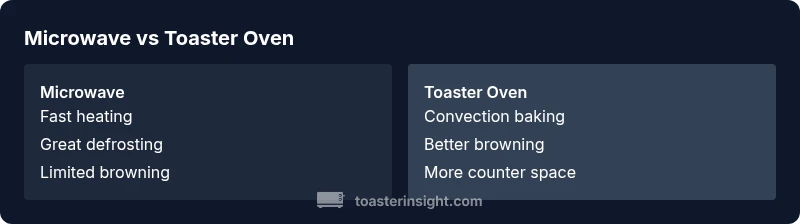
At first glance, microwaves and toaster ovens look similar, but they operate on fundamentally different principles. A microwave heats food by energizing water molecules with microwave radiation, delivering rapid heating with minimal browning. A toaster oven uses radiant and convection heat, enabling baking, toasting, roasting, and browning textures that a microwave cannot achieve. This distinction matters for your daily routines: if you mainly reheat leftovers, a microwave is unbeatable for speed; if you bake small items or crave crispy edges, a toaster oven shines. Understanding these basics helps sets expectations as you compare models and plan your kitchen layout. The keyword that guides this discussion—do you need a microwave and a toaster oven—becomes a question of whether you value speed, texture, or baking versatility as your primary driver.
Performance That Matters: Speed, Temperature Control, and Browning
Performance is the heart of the decision. Microwaves excel at speed, defrosting, and uniform reheating for liquids and soft foods. They are simple to operate, with presets that minimize guesswork. Toaster ovens, on the other hand, offer more precise control over temperature and time, along with browning and crust formation that microwaves cannot replicate. If you regularly bake small batches, toast aggressively, or crave a crisp finish on sandwiches and potatoes, a toaster oven becomes a strong candidate. When evaluating models, pay attention to preheat times, thermostat accuracy, and whether the unit includes convection, which can significantly improve evenness and reduce overall cooking time. Do you need a microwave and a toaster oven? The answer hinges on which tasks you perform most and how important texture and browning are to your meals.
Space, Budget, and Energy: A Practical Lens
Counter space, upfront cost, and ongoing energy use are practical frictions that shape your choice. Microwaves tend to be compact and affordable for basic models, making them attractive for small kitchens where every inch matters. Toaster ovens vary more widely in footprint and price, with compact units ideal for limited counters and larger models offering true oven-like performance. Energy-wise, microwaves can be efficient for quick tasks but may consume more energy per minute when used repeatedly for small items, whereas toaster ovens, when used for baking, may save energy by avoiding the full-size oven’s preheat and bake cycle for small batches. ToasterInsight analysis shows that when you perform multiple small-batch bakes or toast a lot, a toaster oven can yield lower energy use per task, but this depends on frequency and recipe. Balancing space, price, and energy is essential as you answer the question do you need a microwave and a toaster oven.
Use-Case Scenarios: When a Microwave Wins and When a Toaster Oven Shines
Consider typical daily tasks and visualize which appliance would perform them fastest and best. For quick reheating of leftovers or beverages, a microwave is usually fastest, minimizes mess, and preserves moisture with proper power settings. When baking small items like muffins, reheating pizza with a crispy crust, or browning French fries, a toaster oven provides superior texture and flavor. If you host gatherings that require melting cheese or broiling toppings, a toaster oven with convection and a broil option can be more versatile than a microwave. For minimalist spaces or budget-conscious households, starting with one well-chosen unit and expanding later, if needed, is a rational approach. Remember: the best choice aligns with your normal cooking repertoire and the number of meals per week you prepare from scratch.
Real-World Workflows: Small-Kitchen Routines
In a compact kitchen, your workflow matters as much as the appliance itself. A typical weekday sequence might start with using a microwave to reheat lunch quickly, then switch to a toaster oven to toast and crisp a quick dinner. On weekends, you might bake a tray of veggies or small pizzas in the toaster oven while using the microwave for dessert reheating. An orderly setup helps—prioritize easy access to the controls you use most, keep favorites within reach, and ensure cleanup is straightforward. Invest in a crumb tray and easy-to-clean surfaces for toaster ovens, while choosing microwaves with clear control panels to reduce mispresses. The goal is to minimize back-and-forth and make each task as automatic as possible.
Cleaning, Maintenance, and Longevity
Maintenance matters for both devices, but the routine differs. Microwaves require occasional interior wipe-downs and periodic sensor checks to avoid odor buildup. Toaster ovens need more frequent crust removal and crumb cleanup to prevent smoking or odors and to maintain even heating. Use a damp cloth for the exterior and a brush for the crumb tray. Avoid slamming doors or using metal utensils that can scratch interior surfaces. If you use a toaster oven regularly for baking, consider rotating items to even out heat distribution and extending the unit's life. Regular dusting of the vent and keeping the area around the unit clear reduces overheating risk.
Costs and Value: Upfront, Operating, and Replacement
Total cost of ownership matters, not just the sticker price. A basic microwave can be affordable, while a solid toaster oven with convection can represent a bigger upfront investment. If you plan to replace a full-size oven for small-batch meals, a toaster oven can offer cost savings in the long run by reducing energy and preheat time for frequent tasks. Conversely, a microwave may save money and space if your needs are limited to quick reheating and defrosting. The right approach depends on your family’s meal rhythms, how often you cook, and the value you place on texture and browning. ToasterInsight’s view is that evaluating your weekly cooking hours and energy use will guide you toward the most economical arrangement for your home.
Practical Buying and Setup Tips
When shopping, prioritize models with convection (for baking with even heat), accurate temperature control, and a roomy crumb tray for easier cleaning. Check wattage to ensure quick preheats and consider size relative to your counter space. If possible, select a model with presets that mirror your common tasks, such as toast, bake, broil, and smooth defrost. Think about placement: a microwave often fits best at or near eye level for easy access, while a toaster oven needs stable clearance for safe operation. Finally, consider a phased approach: start with one unit and observe your cooking patterns for several weeks before expanding.
Frequently Missed Considerations for Do You Need Both
One often-missed factor is the exact mix of foods you prepare weekly. If you frequently reheat soups or sauces, a microwave’s speed may be irreplaceable. If you bake or toast repeatedly, a toaster oven can genuinely reduce energy use and improve texture. Another consideration is reliability and repair costs; buying from reputable brands with good service reduces long-term headaches. Finally, don’t neglect storage and placement; in some layouts, stacking devices or using a compact, combined unit could save more space than a standalone microwave or toaster oven.
Comparison
| Feature | Microwave | Toaster Oven |
|---|---|---|
| Speed of heating | Very fast for liquids and small portions | Moderate, with baking and browning capability |
| Versatility | Excellent for reheating/defrosting | Excellent for baking, toasting, broiling (with convection) |
| Energy efficiency | Low standby usage; fast cycles | Efficient for small bakes; variable by model |
| Space considerations | Compact footprint common | Larger footprint; depends on model |
| Best for | Quick reheating, defrosting | Small-batch baking and browning |
| Typical price range | $50-150 | $100-350 |
Positives
- Saves counter space by covering many tasks in one device
- Faster cleanup and simpler operation for casual cooks
- Energy efficiency for small meals when used correctly
- Good for small apartments and starter kitchens
Drawbacks
- Toaster ovens can heat unevenly and require monitoring
- Microwaves are unbeatable for rapid reheating and defrosting
- Some tasks still require a full oven or dedicated microwave
- Higher upfront cost if buying both would be necessary
Start with one appliance based on your primary tasks, then add the second if your routines demand it.
If your cooking is dominated by quick reheats, a microwave is the best starting point. If you bake, toast, or crisp foods frequently, a toaster oven adds significant value. Many households benefit from a phased approach: select one device now and reassess after several weeks of real use to determine whether a second appliance is worth the space and cost.
Your Questions Answered
Can a toaster oven replace a microwave for all tasks?
A toaster oven can replace many small baking tasks and provide browning, but it cannot match a microwave for quick reheating or defrosting. If your daily routine relies on speed for liquids or soft foods, you’ll still want a microwave. Use the toaster oven for textures and baking needs, and reserve the microwave for fast, practical reheating.
A toaster oven can handle baking and browning, but a microwave remains unbeatable for quick reheats and defrosting.
Is a microwave necessary in a small kitchen?
Not always. If your meals are mostly reheating or defrosting, a compact microwave may be enough. For homes that bake or toast regularly, a toaster oven with a compact footprint can be a strong alternative. The best choice depends on your cooking habits and space constraints.
In small kitchens, a microwave is often essential for speed; consider a toaster oven if you bake or toast frequently.
What should I look for when choosing between them?
Prioritize temperature control, preheat behavior, and heating evenness. Look for convection in toaster ovens for baking parity with a small oven, easy cleaning features, and size that fits your counter. For microwaves, check wattage, defrost presets, and turntable reliability. Your choice should match your most frequent tasks.
Check power, browning capability, and size to match your kitchen and recipes.
Do they use less energy when used together?
Using both can be efficient if you reserve each appliance for tasks it does best, avoiding unnecessary preheating or long cycles. However, running two devices increases total energy consumption. The key is to align usage with what each appliance does best and avoid duplicate tasks.
Energy efficiency depends on task alignment; use each device for its strengths to avoid waste.
How much counter space do I need?
A microwave typically requires less space than a toaster oven, especially compact models. A toaster oven's footprint varies widely, with some models designed to fit small counters. Measure available space and consider door clearance, ventilation, and placement near outlets.
Measure your counter space and door clearance before buying.
What’s the best starting point for a new kitchen?
Start with the appliance that covers your most frequent task. If you reheat often, pick a microwave; if you bake or toast more, start with a toaster oven. Reassess after a few weeks to decide whether adding the other appliance makes sense.
Start with one device, then reassess after a few weeks to decide if you need the other.
Key Takeaways
- Identify your core tasks to pick the right appliance
- Toaster ovens excel at browning and baking small batches
- Microwaves shine for quick reheating and defrosting
- For many homes, one appliance suffices; add the second if needed
- Consider space, energy, and budget constraints