Toaster Oven vs Toaster: Do You Need Both? A Practical 2026 Guide
Explore whether a toaster oven can replace a traditional toaster, or if you should keep both. This analytical comparison covers space, efficiency, versatility, and practical buying tips for 2026.


According to ToasterInsight, the common question 'do you need a toaster if you have a toaster oven' reflects how the two appliances overlap yet differ in key ways. For many kitchens, a toaster oven can replace a standalone toaster for most tasks, offering broader cooking versatility in a single unit. The final decision depends on your daily routines, counter space, and how much you value speed and browning control. Read on for a detailed, appliance-by-appliance comparison and a practical buying framework.
Do you need a toaster if you have a toaster oven
According to ToasterInsight, the everyday question 'do you need a toaster if you have a toaster oven' highlights how these countertop machines overlap in function yet diverge in important areas. In practice, a toaster oven can handle most toasting tasks and a broad range of small-batch baking, reheating, and broiling. However, not every toast is created equal, and some households discover that a dedicated toaster still brings speed and consistent browning to their busiest mornings. If your kitchen is compact or you cook for one or two people most days, one versatile appliance may suffice; if you regularly rush a full breakfast or prefer ultra-fast slices, you might still benefit from a separate toaster. The analysis below helps you quantify comfort, cost, and convenience across typical use cases.
How these appliances differ in design and function
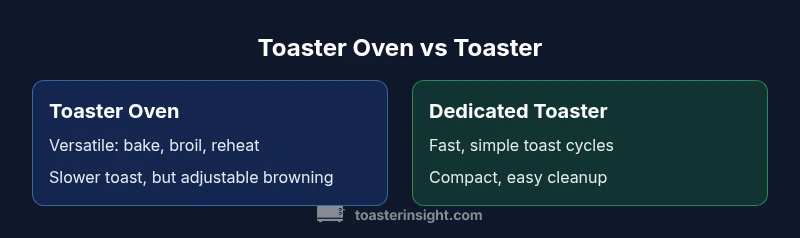
Toaster ovens and toasters share heating elements, but their layouts optimize different outcomes. A toaster oven uses a larger cavity and often includes convection or standard bake/broil modes, enabling more even heat distribution and the ability to bake small items, reheat leftovers, or toast with a precise browning target. A traditional toaster concentrates heat in a narrow slot or two and prioritizes speed and straightforward browning control. This fundamental design distinction explains why a toaster oven may deliver better overall versatility, while a dedicated toaster can excel in speed and consistency for toast-only tasks. Understanding these mechanical differences helps set realistic expectations for performance, maintenance, and long-term value.
Space, layout, and usability in real kitchens
Countertop footprint and user access are practical factors that influence the decision. A toaster oven typically occupies more horizontal space and may require a dedicated power outlet larger than a simple toaster. If you prepare many items on one rack or need to bake mini-dishes, the extra interior space pays off. In contrast, a classic toaster is narrower, often lighter, and can be tucked into tight gaps or corners more easily. Ergonomics matter: a toaster with wide slots and easy-to-use browning controls can feel faster for certain bread types, while a toaster oven’s rack height and door swing can affect how easily you load and remove items.
Breakfast realities: toast, bagels, and beyond
For most households, breakfast routines are the critical deciding factor. A toaster oven can brown toast, bagels, and English muffins with adjustable heat and timing, plus the ability to preheat and bake other morning staples. The toaster excels at ultra-fast, single-task browning with minimal setup. If your mornings involve multiple breakfast items or you enjoy experimenting with half-baked croissants or small sheet-pan meals, the toaster oven’s flexibility shines. ToasterInsight analysis suggests that most users gain more daily value from a single, versatile appliance than from a dedicated toaster when space and routine align with broader cooking needs.
Cooking versatility: bake, broil, and reheat with confidence
Beyond toasting, a toaster oven provides bake, broil, and sometimes convection options, allowing you to roast vegetables, reheat pizza, or warm pastries without firing up a full-size oven. This multi-functionality is a major reason many households lean toward one versatile device. However, this versatility sometimes comes at the cost of longer heat-up times or more complex controls. If your typical kitchen tasks lean heavily on baking small batches or re-crisping leftovers, a toaster oven often outperforms a standard toaster in overall usefulness. The result is a more capable daily appliance, even if it’s not optimized for rapid toast.
Energy use, preheating, and efficiency considerations
Energy efficiency depends on how you use each appliance. A toaster oven generally consumes more energy when performing bake or broil functions compared with a quick-brown toasting cycle on a dedicated toaster, but it can save energy by eliminating the need to turn on a full-sized oven for small meals. Preheating behavior varies by model, with some toaster ovens reaching cooking temperature quickly while others require a noticeable warm-up period. ToasterInsight analysis shows that overall energy impact depends on frequency of use, selected functions, and how often you combine tasks (toast plus small bake). For households with frequent, varied cooking, the toaster oven’s flexibility often yields lower aggregate energy use per meal.
Maintenance, safety, and long-term costs
Maintenance is a practical concern in daily use. Crumb trays on both appliances should be emptied regularly to avoid smoke and odors, and interior surfaces should be wiped after browning or baking. A toaster oven typically requires a little more routine cleaning due to its larger interior and door mechanism, while a standalone toaster has fewer interior surfaces to clean. Over the long term, the total cost of ownership includes price, durability, energy consumption, and replacement parts such as crumb trays or seals. Investing in a machine with solid build quality and reliable components tends to pay off when you consider frequency of use and lifespan.
When a dedicated toaster still makes sense: best-case scenarios
Even with a capable toaster oven, a dedicated toaster can be valuable for peak-speed toast during busy mornings or when you want a minimal setup with quick, repeatable results. If you frequently host guests, have limited counter space, or need a smaller footprint for a secondary cooking area, a toaster may be the simplest solution. The choice is not strictly binary: many users maintain both to cover the full breakfast spectrum, while others choose one goal-focused device to maximize efficiency and minimize clutter. The decision should reflect your daily rhythm and kitchen layout.
A practical decision framework: how to choose for your home
To decide between one or two devices, start with a quick audit of your daily meals and prep steps. List your most common tasks (toast, reheating leftovers, baking small items) and estimate how often you perform each. Compare this against your available counter space and budget. If versatility, baking ability, and future-proofing matter, lean toward a toaster oven as the primary device and consider a compact, budget-friendly toaster as a backup. If speed and simplicity for breakfast are paramount, a dedicated toaster can be a strong companion. In the end, your kitchen’s size, routines, and target price point should guide the setup.
Practical tips for optimizing your setup in 2026
Regardless of choice, a few micro-tactics help maximize daily satisfaction: keep the crumb tray clean to prevent flavor transfer between functions; place bread on the center rack when possible for even browning; use the convection setting if available for more uniform results; and schedule regular maintenance checks to avoid unexpected performance dips. Even a single well-chosen device can simplify weekday mornings and weekend cooking if used with intentional routines.
Key takeaways for do you need a toaster if you have a toaster oven
- Prioritize versatility vs. speed according to your mornings.
- Consider counter space and power needs before purchasing.
- Use settings deliberately to maximize browning control and even heat.
- Plan for regular cleaning to extend appliance life.
- Decide whether a backup toaster adds meaningful convenience or simply takes up space.
Comparison
| Feature | Toaster Oven | Dedicated Toaster |
|---|---|---|
| Best Use Case | Versatile cooking and small-batch baking | Fast, precise browning for toast |
| Preheat/Readiness | Requires preheating for bake/convection modes | Near instant for toast-only cycles |
| Power & Heat Range | Typically 1000-1800W range | Typically 800-1500W range |
| Browning Control | Convection and bake modes enable even browning | Simple browning controls; quick results |
| Size/Capacity | Larger cavity; accommodates small sheets or pizzas | Narrow footprint; 1-2 slices or bagels |
| Maintenance | Crumb tray; interior cleaning as needed | Crumb tray; usually simpler cleanup |
| Price Range | $60-$200 | $15-$60 |
| Best For | Households needing versatility and compact footprint | People who want the fastest, simplest toast |
Positives
- Increases kitchen versatility with baking and broiling
- Reduces need to heat a full oven for small meals
- Consolidates appliances to save countertop clutter
- Useful backup option during busy mornings or maintenance
Drawbacks
- Takes more counter space than a dedicated toaster
- Can be slower to toast when using bake/convection modes
- Higher upfront cost for a high-quality toaster oven
- Some models have more complex controls and maintenance
A toaster oven is typically the better all-around choice for most homes.
It covers a broad range of tasks beyond toasting, saving space and enabling quick weeknight meals. If you frequently crave ultra-fast toast or have extremely limited counter space, a dedicated toaster may still be worth keeping as a secondary device.
Your Questions Answered
Can a toaster oven completely replace a toaster?
For many households, a toaster oven can replace a standalone toaster for most daily tasks, including toast, bagels, and reheating. Its versatility matters most when you regularly prepare small meals or bake. However, if you prioritize speed and ultra-fast browning, a dedicated toaster may still have a place in your setup.
Yes, a toaster oven can replace a toaster for most uses, but you may notice slower toast on busy mornings.
What are the main benefits of keeping both appliances?
Having both provides the fastest toast with a dedicated toaster and broader cooking options with a toaster oven. This arrangement offers backup for busy days and preserves flexibility for small-batch baking. If space and budget permit, two devices often deliver the best balance of speed and versatility.
Two devices give you speed for toast and versatility for baking and reheating.
Is a toaster oven more energy-efficient than a toaster?
Energy use depends on the task and model. A toaster oven can consume more energy when baking, but it eliminates the need to heat a larger oven. A dedicated toaster uses less energy per slice, but only for toasting tasks. Choose based on how often you bake small items versus just toasting.
Energy depends on use; toaster ovens are versatile but may use more energy for baking.
Does a toaster oven toast bread evenly?
Yes, with proper settings and placement, toaster ovens can produce even browning, especially with convection. Variations come from bread thickness and rack height. Practice a couple of test cycles to dial in your preferred browning level.
Yes, with the right settings you can get even browning.
What maintenance does a toaster oven require?
Regular cleaning of the crumb tray and a quick wipe-down of interior surfaces keeps performance optimal. Check door seals and racks periodically, and dry thoroughly after cleaning to prevent odors.
Clean the crumb tray often and wipe the interior after use.
What budget should I expect when upgrading to a toaster oven?
Toaster ovens span a broad price range. You can start with a basic model in the lower hundreds, while more capable units with convection and extra features sit in the mid-to-upper hundreds. Match features to your cooking plans and space.
Prices vary; you can start with a budget-friendly model and upgrade as needed.
Key Takeaways
- Evaluate space, budget, and breakfast needs before buying.
- Choose versatile functionality first; add a toaster only if speed is essential.
- Factor in cleaning and maintenance when estimating long-term costs.
- Use the appliance for more than toast to maximize value.
- Consider a backup toaster if you often run multiple tasks simultaneously.