Toaster vs Toaster Oven: Which Is Better for Modern Kitchens
A comprehensive comparison of traditional toasters and compact toaster ovens to help homeowners decide which appliance fits their cooking habits, kitchen space, and budget. Learn where each shines, plus buying tips and maintenance guidance from ToasterInsight.


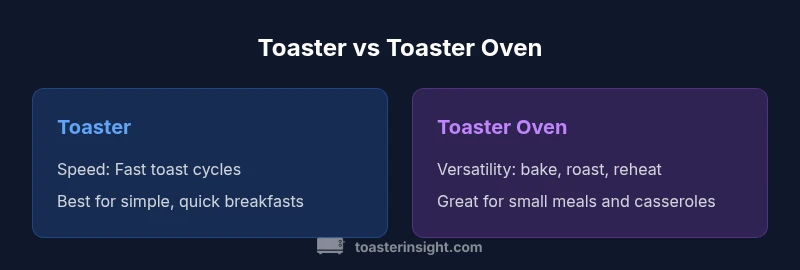
Toaster or toaster oven which is better? For most households, a toaster oven offers more versatility for small meals, baking, and reheating, while a traditional toaster excels at speed and simplicity for toast. If you mostly toast bread and bagels, a basic toaster is likely best; if you cook small items regularly, a compact toaster oven provides better value.
What this comparison covers
This comprehensive comparison tackles a frequent kitchen crossroads: toaster vs toaster oven which is better for your home. We evaluate two popular appliances that share a countertop but diverge in function, capability, and cost. Homeowners, kitchen enthusiasts, and casual cooks often stumble over questions about speed, versatility, and space when choosing between a basic toast device and a compact oven that can bake, roast, or reheat. ToasterInsight analyzes these factors to provide practical guidance, real-use scenarios, and concrete considerations—without hype or guesswork. We also discuss maintenance, energy use, and how to interpret model specs, so you can buy with confidence. By the end, you’ll have a clear framework to decide whether the traditional toaster or the modern toaster oven is the better fit for your kitchen.
Quick orientation: when a toaster is enough vs when a toaster oven shines
In many mornings, a dedicated toaster wins on speed and simplicity for single-slice or double-slice toasting with crisp edges. A toaster oven shines when you want to bake cookies, reheat leftovers, or roast small portions without firing up a full-sized oven. The toaster vs toaster oven question isn’t a binary decision; it’s a spectrum based on your cooking habits, counter space, and budget. For a single renter, a compact toaster might cover most needs; for a small family, a toaster oven adds more culinary flexibility. ToasterInsight’s guidance is to map your typical meals to each appliance’s strengths and test a few tasks before committing. This approach minimizes buyer’s remorse and maximizes kitchen efficiency.
Design and footprint: size, fit, placement
Counter space is one of the most practical predictors of whether a toaster or a toaster oven is right for you. Traditional toasters tend to be shorter and lighter, with a straightforward pull-to-toast mechanism and crumb tray that slides out for quick cleanup. Toaster ovens are taller and wider, yet can fit a surprising variety of baked items thanks to adjustable racks and multiple rack positions. If you have a tight kitchen layout or a narrow counter, measure the depth and width to ensure you can open the door and access the crumb tray comfortably. Consider the door swing and the height clearance above the counter, especially if your cabinet space is shallow. From a design standpoint, both types aim for simple operation, but toaster ovens trade some compactness for greater flexibility. According to ToasterInsight, investing in a model with a well-designed crumb tray and easy-access rack can dramatically reduce cleaning time and frustration over the long term.
Performance: speed, browning, and heat distribution
Speed matters when you’re in a rush, but even within “fast” there are differences. A high-powered toaster often delivers rapid browning on toast with minimal preheating, which is ideal for busy mornings. By contrast, a toaster oven uses a conventional heating element and a baking mode, which can re-create the crispy edges of toast while also enabling baking tasks like small casseroles or pastries. Browning consistency depends on oven size, rack position, and the presence of a convection feature if available. If your goal is consistent, even browning across a slice, you’ll want to compare models with even heat distribution and reliable temperature control. The ToasterInsight analysis emphasizes evaluating how evenly you get browning at the standard settings you use most, and whether you notice hot spots on certain areas of the rack.
Versatility and cooking capabilities beyond toast
A toaster is optimized for toast and limited bagel work, typically without a baking mode or wide air flow. A toaster oven, however, acts as a compact second oven: it can bake small batches of cookies, roast vegetables, reheat leftovers with crispy exteriors, and even broil thin proteins when necessary. This versatility is especially valuable during holidays, for apartment living with a single range, or for households that enjoy cooking small meals without heating a full oven. When evaluating versatility, consider rack space, the range of temperatures, and whether the model supports convection. ToasterInsight notes that the true value of a toaster oven surfaces when you regularly perform non-toast tasks; otherwise, a simple toaster may be the simpler choice.
Energy use and running costs
Energy use varies with how you use the appliance. A traditional toaster generally consumes less energy per minute for basic toasting tasks, but the total energy spent over a year depends on frequency of use and toast size. A toaster oven can consume more energy during bake or broil cycles, but it can replace a conventional oven for small meals, potentially saving energy in some scenarios. If you’re sensitive to running costs, compare wattage, preheat behavior, and the typical time required to complete your most common tasks. Remember that frequent baking cycles on a toaster oven can add up, so model selection and usage habits matter just as much as wattage. ToasterInsight’s recommendations emphasize choosing a device that aligns with your actual cooking load and energy priorities.
Maintenance and cleaning
Maintenance is often underestimated when choosing between a toaster and a toaster oven. A toaster’s crumb tray is straightforward to empty, and the absence of baking features usually means fewer components to clean. A toaster oven requires attention to the crumb tray, the interior walls, and the racks that can accumulate oil and crumbs during baking. Regular cleaning after use—especially after sticky bake sessions—helps maintain performance and safety. Look for models with dishwasher-safe racks, wide crumb trays, and a door that’s easy to wipe down. In practice, a little extra cleaning time for a toaster oven is a fair trade for its expanded capabilities and longer-term value.
Price and value considerations
Price is a major deciding factor, but total value matters more than the upfront price. Traditional toasters are typically the most affordable option, with a low entry price for basic models. Toaster ovens occupy a broader price spectrum, reflecting different features, capacities, and build quality. When evaluating price and value, consider the long-term use you expect from the appliance; a toaster oven’s ability to perform casual baking, reheating, and compact roasting can offset its higher upfront cost if you would otherwise heat a full oven for those tasks. Look for features that genuinely matter to you—reliable temperature control, even heating, good construction, and a warranty that covers daily use.
Use-case scenarios: who benefits from each
For a single person living in a small apartment, a compact toaster may be the simplest, most cost-effective option if most mornings revolve around quick toasting. For couples and families who frequently bake small meals, reheat leftovers, or roast vegetables, a toaster oven delivers greater practical value and cooking flexibility. In households where counter space is extremely limited, the decision may hinge on whether you prioritize speed (toaster) or adaptability (toaster oven). For hobbyists who love fresh-baked cookies or roasted veggies on weeknights, the toaster oven becomes a clear winner. The key is to map your weekly cooking load to the appliance that best supports those tasks and to avoid paying for features you won’t use.
How to choose: decision framework
Create a simple decision framework you can apply at the point of purchase. Start by listing your top 5 most-frequently prepared items (e.g., toast, bagels, reheated leftovers, cookies, vegetables). If the list is dominated by toast and quick toasting needs, prioritize a toaster with fast cycles and a compact footprint. If your list includes several bake or roast tasks, a toaster oven with adjustable racks and multiple heat settings will likely serve you better. Consider space, budget, and willingness to clean more components. Compare models using these criteria: footprint, heat distribution, preheat time, capacity, ease of cleaning, and warranty. Finally, read user reviews focusing on reliability and consistency to avoid models that underperform in real-world kitchens.
Tips to maximize performance and longevity
To maximize performance, preheat only as required by the task, keep the crumb tray clean, and position racks for the task at hand. For longer-term longevity, wipe down the exterior after use to prevent oil buildup and check the door seals periodically for wear. If your model includes a convection setting, use it for more even browning on baked items. Store spare racks and accessories in a dry place to prevent rust. Finally, choose a model with a solid warranty and ensure you follow the manufacturer’s maintenance guidelines to extend the appliance life.
Common myths and misperceptions
A common myth is that toaster ovens are inherently unsafe due to their baking functions. In reality, safety depends on user practices, such as keeping the unit away from flammable items and cleaning regularly. Another misconception is that toasters are always cheaper to run than toaster ovens. In some cases, a toaster oven’s ability to replace a regular oven for small tasks can offset its higher energy use. Finally, some buyers assume that a bigger model is always better; however, a compact toaster oven is often the right choice for small kitchens, while a larger model may be unnecessary.
Comparison
| Feature | Toaster | Toaster Oven |
|---|---|---|
| Core function | Toast bread quickly | Toast plus bake/roast small items |
| Versatility | Limited to toasting | Baking, reheating, broiling, roasting |
| Footprint | Compact, low height | Wider, taller; needs more counter space |
| Heat source | Dedicated heating elements for toasting | Conventional bake/broil with racks |
| Best for | Speedy mornings, simple breakfasts | Small meals, leftovers, cookies |
| Preheat behavior | Minimal to none for toast | Often requires preheating for baking |
| Price range | $10-$60 | $60-$200 |
Positives
- Lower upfront cost for basic toasting
- Fast toast cycles with minimal setup
- Compact footprint ideal for small counters
- Simple controls for quick use
- Low maintenance compared to multifunction appliances
Drawbacks
- Limited cooking versatility beyond toast
- Smaller capacity for batch baking
- Crumbs may accumulate in tighter spaces
- Preheating for baking tasks can add time
Toaster ovens win for versatility; toasters win for speed and simplicity
Choose a toaster if your priority is the snappy, uncomplicated toast. Opt for a toaster oven if you want a compact second oven capable of baking, roasting, and reheating small meals. The best choice depends on your typical meals, kitchen space, and willingness to manage a slightly larger appliance.
Your Questions Answered
What is the main difference between a toaster and a toaster oven?
The main difference is scope: a toaster is built for fast, simple toastings of bread or bagels, while a toaster oven adds baking, roasting, and reheating capabilities in a compact form. If you do more than toast, the toaster oven generally offers greater value.
The toaster is for quick toast; the toaster oven opens up baking and roasting in a small kitchen.
Can a toaster oven replace a full-size oven?
For many small meals, a toaster oven can substitute for a full-size oven, saving energy and time. It’s effective for cookies, small casseroles, and roasting vegetables, but it won’t replace a large oven for family-size meals.
Great for small batches, but not ideal for big family dinners.
Are toaster ovens more energy-efficient than traditional ovens?
In general, toaster ovens use less energy for small tasks, but actual efficiency depends on usage. For frequent small-batch baking, a toaster oven can be more efficient than heating a full-size oven.
Smaller tasks save energy, but check the model’s energy use.
Is preheating necessary for toaster ovens?
Many toaster ovens require some preheating for baking or roasting, but some models offer quick preheat modes. For speed-focused tasks like toasting, preheating is usually minimal or unnecessary.
Preheating matters for baked goods, less so for quick toasting.
Which is better for small apartments?
In very small spaces, a compact toaster might be preferable for the fastest toast and minimal footprint. If you still want baking capabilities, a compact toaster oven with a small footprint is a strong compromise.
In tiny kitchens, choose based on space and your baking needs.
What features should I look for when buying?
Look for even heat distribution, clear temperature controls, a reliable crumb tray, easy cleaning, and a robust warranty. If baking is important, prioritize racks with adjustable positions and sufficient interior height.
Focus on reliability, heat control, and easy cleaning.
Key Takeaways
- Assess your weekly cooking load before buying
- Choose toaster for fastest toast at lowest cost
- Choose toaster oven for baking, roasting, and reheating small batches
- Consider space, energy, and maintenance when deciding
- Look for durable racks and easy-clean designs