Oven Toaster Griller vs Microwave: Practical Comparison
Compare oven toaster griller and microwave side-by-side. Discover which excels in speed, browning, and versatility to help homeowners pick the right kitchen appliance.


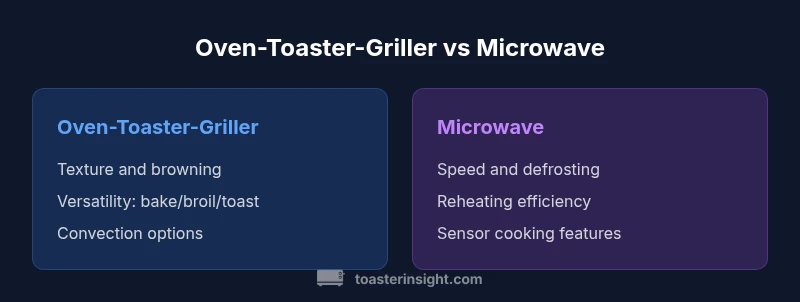
Overview: For most homes, the microwave delivers speed for reheating, defrosting, and quick meals, while the oven toaster griller provides browning, baking, and versatile cooking. If your daily tasks involve frequent reheat, the microwave is the better fit; if you bake or want crisp results, the oven toaster griller excels. The right choice depends on your typical tasks to balance speed and versatility.
The core differences: what each appliance does and where it shines
The oven toaster griller (OTG) and the microwave occupy different ends of the kitchen appliance spectrum. The OTG combines a traditional oven with a toaster and grill, delivering browning, roasting, and baking with a crusty finish that imitates a full-size oven. The microwave relies on electromagnetic waves to heat water molecules, offering speed and convenience for reheating and defrosting. When you compare the two, the OTG shines where texture and crust are essential, while the microwave shines where speed and simplicity matter. For many households, the decision comes down to balancing tasks: do you need crispy toast and baked goods, or rapid reheating for leftovers? This guide compares the two appliances holistically, highlighting typical use cases, maintenance considerations, and practical buying tips. Throughout, oven toaster griller vs microwave remains a useful framework for evaluating needs in real kitchens.
According to ToasterInsight, many homeowners prioritize texture and speed differently based on daily routines, which is why a direct feature-by-feature comparison helps ensure you pick a model that truly fits your cooking habits. Keep an eye on how often you bake, toast, or grill versus how often you reheat and defrost. A single unit may satisfy both sets of tasks if designed with versatile modes, but it may not excel at every task equally. The goal is to identify your top three tasks and assess which appliance handles them best.
Performance in practice: speed, texture, and versatility
Efficiency in the kitchen often hinges on real-world results, not marketing buzzwords. The microwave excels at speed: it heats evenly for small portions, defrosts without preheating, and completes reheating in minutes. However, foods that rely on browning, crust formation, or caramelization may come out uneven or soggy in a microwave without specialized features. The OTG provides more control over texture: it browns, crisps, and caramelizes surfaces, producing pizza crusts with a crustier edge, roasted vegetables with caramelized edges, and baked goods with a familiar crumb. While not as instantaneous as a microwave, the OTG can deliver oven-like results on smaller portions without the need to transfer to a full-size oven. In practice, many cooks use the microwave for quick tasks and the OTG for meals that benefit from browning and even heat distribution. The decision often comes down to your most common meals and whether you value speed over texture or vice versa.
Another factor is versatility. A high-quality OTG often supports bake, broil, toast, and roast modes, expanding your repertoire beyond reheating. A microwave may also include convection or grilling options in higher-end models, narrowing the performance gap but still with different strengths. The bottom line: if your kitchen rhythm includes both rapid reheating and crusty results, a model with both capabilities can be compelling. If you lean toward single-task efficiency, prioritize the mode you use most and select accordingly.
Energy efficiency and cost of ownership
Energy use and cost of ownership are practical considerations that matter over the long term. Microwaves typically consume less energy per minute for small tasks, making them efficient for quick reheating and light defrosting. OTGs, especially those with convection or grill features, can consume more energy per cycle but may save time by completing broader tasks in a single session. Over months and years, the number of uses per day influences your total energy footprint and operating cost. When evaluating energy use, also consider standby power, insulation quality, and preheat duration. A well-insulated OTG with a short preheat time can minimize energy waste for modest batches. In contrast, a microwave’s standby and efficiency are generally stable, but you may incur higher energy costs if you frequently heat bulky or dense foods that take longer. ToasterInsight’s takeaway: balance your task mix with an eye on both immediate energy use and cumulative costs over time.
Beyond energy, price is a factor. Microwaves are often less expensive upfront than OTGs with convection or grill functions. If budget is tight and your tasks are mostly reheating, a compact microwave can be the sensible choice. If you anticipate regular baking, browning, or roasting, investing in an OTG with robust features may deliver better long-term value. The best approach is to estimate your weekly use and multiply by typical energy costs to compare annualized costs.
Practical buying scenarios: when to pick each appliance
Decision-making becomes clearer when you map your actual cooking scenarios. Scenario A: You host weekly gatherings with pizza, roasted vegetables, and small baked items. Scenario B: Your household relies on quick reheats, frozen meals, and simple defrosting. For Scenario A, the oven toaster griller is a strong fit due to its browning and baking capabilities. For Scenario B, the microwave shines with speed and convenience. If you have limited counter space but want to cover both worlds, look for compact OTGs with convection and a dedicated microwave with defrost and sensor cook features. If you have the room, many kitchens benefit from a dedicated microwave plus a separate OTG. Your choice should reflect how often you perform certain tasks rather than counting features alone. Remember, a well-chosen unit helps you avoid extra tools and streamlines dinner prep.
Consider your typical meals and how often you bake versus reheat. If you primarily reheat leftovers and rehydrate frozen items, the microwave is likely your best friend. If you bake cookies, roast peppers, or crisp a slice of toast, the OTG takes the lead. For users who want both performance envelopes, a two-appliance setup or a high-quality OTG with a separate microwave can be the most satisfying route. Budget and counter space should guide the final decision, alongside practical testing in-store where feasible.
Common myths and limitations
A frequent myth is that microwaves cannot brown food. While traditional microwaves do not brown, many modern models incorporate grilling or convection modes that mimic browning. Another misconception is that OTGs always replace full-size ovens. While OTGs can bake and roast, their capacity is smaller, making them less ideal for large batches. Some buyers assume OTGs heat faster than microwaves; in practice, microwaves typically win for quick reheats, but OTGs may outperform microwaves on texture and crust. Finally, be cautious about adding extra features you won’t use. A feature-rich model can complicate operation and maintenance without delivering real value if your daily tasks don’t require it.
In short, neither appliance is inherently superior across every task. The best choice hinges on your cooking habits, kitchen space, and energy priorities. ToasterInsight emphasizes evaluating your year-round usage patterns and selecting a model that aligns with your top three tasks.
How to use each appliance well: tips and best practices
To maximize performance, start with clear settings. For the OTG, preheat only as needed and use the grill or convection modes for crisping; avoid overcrowding to maintain even heat. Place foods on appropriate racks to optimize air circulation and browning. For the microwave, use power levels appropriate to the task and cover foods to prevent moisture loss; rotate or stir for even heating and avoid overcooking delicate items. Use microwave-safe containers and follow recipe timing to reduce moisture loss. If your OTG includes a convection feature, consider a quick preheat for more consistent results when baking or roasting. Regularly clean crumb trays and interior surfaces to prevent odors and ensure consistent performance. Energy-aware usage, such as preheating only when necessary and using microwave defrost for frequent frozen items, will help you conserve energy over time.
Finally, read the user manual to understand the limits of each mode. Some OTGs have specialty features like air frying or rotisserie that require careful temperature and time adjustments. Practicing with simple recipes can help you learn the best settings for different foods before attempting more complex meals.
Cleaning, maintenance, and longevity
Routine cleaning is critical for both appliances. After heavy use, remove crumb trays from the OTG and wipe down interior surfaces with a damp cloth. For the microwave, wipe the interior after reheating fatty foods because residue can affect flavor and odor. Avoid harsh abrasives that can damage coatings. Caution is needed with metal objects in the OTG to prevent arcing and electrical issues. Regularly inspect door seals and hinges for signs of wear, as a compromised seal can reduce efficiency. For longer-term longevity, schedule occasional deep cleaning and follow manufacturer recommendations for descaling or deodorizing if available. Proper maintenance reduces odor transfer between the two appliances and extends their useful life.
Real-world kitchen setups: case studies and decision trees
In many kitchens, homeowners rely on a microwave for daily speed and an OTG for rare but important tasks like baking and browning. A common approach is to situate the microwave in an easily accessible spot for quick meals, with the OTG on the counter where it can be preheated and used for crisping. A decision tree helps: start with your primary task (reheat vs bake), check whether you need texture (crust) or speed (quick heating), and then pick the model that best matches your needs. If you frequently switch between tasks, consider a model with multiple modes, such as toast, bake, grill, and convection, to cover a broad spectrum without moving pots between devices. This practical framework—identify your top three uses, match them to the appliance capabilities, and verify space and price—will help you select wisely.
Quick-start decision checklist
- List your top three tasks (reheating, browning, baking).
- Measure counter space and plan for placement near outlets.
- Compare energy use for your typical batch sizes.
- Evaluate if you need a single unit or two dedicated appliances.
- Check for convection/grill features if you want oven-like results without a full oven.
Comparison
| Feature | Oven-Toaster-Griller | Microwave |
|---|---|---|
| Cooking speed / Reheating Time | Moderate speed; good for small to medium batches | Fast reheating and defrosting; best for quick meals |
| Texture and Browning | Excellent browning and crust formation | Limited browning; moisture retention varies by model |
| Versatility | Bake, broil, toast, roast, grill | Reheat, defrost, basic cooking; some models with convection |
| Footprint & Space | Larger footprint; may require more counter space | Typically compact, fits in smaller kitchens |
| Energy Use | Higher per-use energy; efficient for texture tasks | Lower per-task energy for quick reheats |
| Preheating | Preheating recommended for best results | No preheating required for many tasks |
| Upfront Cost | Moderate to high depending on features | Generally lower upfront cost |
| Best For | Baking, browning, and versatile meals | Speedy reheating and simple meals |
Positives
- Broad versatility for baking, grilling, and toasting
- Very fast reheating and defrosting with microwave
- Crisp texture and crust control with OTG for certain foods
- Consolidates multiple functions in one unit when space is limited
- Convection options in OTGs improve even cooking
Drawbacks
- Microwave can dry or unevenly heat certain foods if misused
- OTG often requires longer preheating and larger footprint
- Higher upfront cost for OTG with convection or grill
- Maintenance can be more involved due to multiple functions
Both appliances have a place; choose based on your primary tasks and space
If speed and defrosting are your main needs, go microwave. If browning, baking, or crisp textures matter, choose the oven-toaster-griller. For many kitchens, a combination approach offers the best balance.
Your Questions Answered
What is the primary difference between oven toaster griller and microwave?
The oven toaster griller combines baking, roasting, and browning; the microwave emphasizes speed for reheating and defrosting. The choice hinges on whether texture or speed is more important for your cooking habits.
The main difference is what they optimize for: texture and baking vs. rapid heating.
Can I replace a microwave with an oven toaster griller for everyday reheating?
You can reheat many foods, but you may miss fast defrosting and the convenience of quick heating. The OTG excels in texture, not necessarily speed.
Yes, but you’ll trade speed for browning and versatility.
Are there energy-efficiency differences I should consider?
Microwaves typically use less energy for small tasks; convection-enabled toaster ovens can be efficient for larger meals when used for longer, roasting-style tasks.
Microwaves are usually more energy-efficient for quick jobs.
What foods brown best in an oven toaster griller?
Bread, pastries, vegetables, and dishes that benefit from caramelization tend to brown well in an OTG.
Bread and roasted veggies brown nicely.
How do preheating times compare?
Microwaves require little to no preheating; toaster-oven griller benefits from preheating for even results, though some tasks don’t require it.
Preheating matters more for the oven-style unit.
How should I clean and maintain these appliances?
Follow manufacturer guidelines, remove crumbs, and wipe interior surfaces with a damp cloth. Regular cleaning extends performance and odor control.
Regular cleaning helps performance and longevity.
Key Takeaways
- Assess your primary tasks first to balance speed and browning
- Measure countertop space before buying to ensure fit
- Prioritize models with convection or grill for versatility
- Keep cleaning tools handy to maintain performance
- Choose a unit with both functions if your tasks vary